Replacing Corn Syrup For A ‘Cleaner’ Label
Unlike many food items that use corn syrup to stretch the product and reduce cost, corn syrup in candy is highly functional.
Today’s market focus on “clean label” requires reviewing all the ingredients in a product. Often, this means considering replacing the corn syrup in confectionery. But unlike many food items that use corn syrup to stretch the product and reduce cost, corn syrup in candy is highly functional. Replacing corn syrup with tapioca syrup, brown rice syrup, oat syrup, or other grain syrup is not a simple task. Knowing the basics of corn syrup, what it’s contributing, and how it’s interacting with other ingredients is the key to understanding how to replace it.
Most sugar confectionery, including hard candies, gummies, jellies, marshmallows, and caramels, is impacted by the combination of sucrose and corn syrup, or the “Sugar/Syrup ratio”. This ratio is considered the sweetener system for the recipe, and is determined on a dry weight basis. Dry weight basis is calculated by subtracting out the water portion of each ingredient and using only the solids to determine the percent content. Sucrose is considered 99.9 percent solids, and corn syrups are usually around 80 percent solids.
A perfectly textured piece can become grainy, melt and deform at room temperature (cold flow), or not brown properly during cooking all due to the ratio being incorrect for that product and process. Therefore, simply removing corn syrup isn’t an option. Understanding the functionality of syrup, and how other grain syrups differ from corn syrup, can help drive the development.
DE and carbohydrate profile
Perhaps the most important characteristic of corn syrup is DE, but only because that’s what we talk about the most! Most syrups are named by their DE, which stands for Dextrose Equivalent. Technically, DE is the percentage of reducing sugars (small molecules) in a corn syrup. The two most used corn syrups in confectionery are 43 DE and 63 DE. In general, a higher DE syrup will:
- be sweeter
- brown faster
- flow faster (lower viscosity)
- add less body
- provide less “stretch”
The Carbohydrate Profile is far more important than DE in determining the properties a syrup adds to a candy item, because the viscosity and other behaviors of corn syrup are dependent upon the carbohydrate profile (aka sugar profile) distribution. Large, chunky sugars (high molecular weight polysaccharides) increase the viscosity, and thus make it thick and difficult to flow. A low DE syrup will have more large sugars, and therefore high viscosity. High viscosity syrup will provide more body or mouthfeel, and prevent graining the best. However, it will also delay flavor release and increase defects such as tailing during depositing.
Texture
In the production of candy, the corn syrup and sugar are blended together and heated to a specific temperature for a defined amount of time. This achieves a defined finished solids level in the candy. The sugar and syrup combination — in addition to water — is often referred to as the “Bob”. Gelling agents and milk may be added to the bob before cooking. Flavor (including fruit powder), color and acid are added after cooking and ideally seconds before depositing.
The boiling point of the bob will increase as the amount of corn syrup increases, or as the average molecular weight of the corn syrup decreases. The lower weight sugars (dextrose and fructose) will also brown faster than larger molecular sugars.
A 30-35 percent corn syrup on a dry weight basis in relation to sugar is a good starting point for developing a product, with adjustments for processing and texture preferences. Hard candy usually starts around 60/40 sugar to corn syrup, remembering that we’re referring to dry weight basis. Typically, 3-5 percent corn syrup is added to hard sugar shell panning solutions to help control the crystallization, whereas jelly bean engrossing syrups range from 60-85 percent corn syrup. Pectin, gelatin, and starch gel textures can all be adjusted by changing the proportion of corn syrup to sugar, or by changing to a different carbohydrate profile syrup. These gels tend to range from 40/60 to 60/40 sugar to syrup.
Graining
The graining rate of hard candy is the simplest example of the effects of corn syrup. Corn syrup is added to the sugar and water blend to act as a “doctoring agent” to inhibit graining. In production, agitation through mixing and pumping will initiate graining. Larger batches or continuous production will increase this mechanical shear, and require increasing the corn syrup or changing to one with a larger molecular profile.
Adding fruit powders or dry flavors to a product will affect the sugar/syrup ratio. These items tend to act as the sugar portion of the ratio, and can be calculated as such. However, fruit powders tend to be mostly fructose and therefore are more hygroscopic and brown faster than sucrose.
Hygroscopicity
When a candy become sticky when sitting at room temperature and it doesn’t contain acid, it’s because it is drawing moisture from the air. The likelihood the product will pull moisture from the air is referred to as hygroscopicity. A higher DE syrup will tend to increase hygroscopicity, although the whole carbohydrate profile determines this more.
Tapicoa, rice, oat and other syrups
Today, the demand for formulations that change out corn syrup for brown rice, oat, and other options continues to grow. Suppliers will often state that the replacement syrup can be “dropped in” one for one in place of corn syrup. Although the syrups may pour and stir into the product in a similar way, they are not direct replacements! Again, it is the carbohydrate profile that defines behavior. Asking that the specification includes the carbohydrate profile (sometimes called Sugar Profile), or sending out to an independent lab, is key to determining how close it is to the current syrup in a product. Often a mix of syrups will be required if looking to match a particular texture and flavor.
Also, these syrups impart their own flavor and color that must be considered during development. Ask if the supplier can provide consistent material, or recognize the finished product may change according to growth and harvest conditions of the base material. Ensure the ingredient is independently tested for heavy metals, as brown rice syrup has been shown to have high levels of arsenic. Know the country of origin of the material, and consider the food safety and environmental controls in that country in the decision to change syrups. Finally, because these syrups are not as clarified as corn syrup, they will vary from supplier to supplier.
For all of these reasons, replacing corn syrup in a confectionery recipe requires a significant amount of testing; high quality ingredients from vetted suppliers; and fully understanding all the functionality corn syrup imparts to a product.
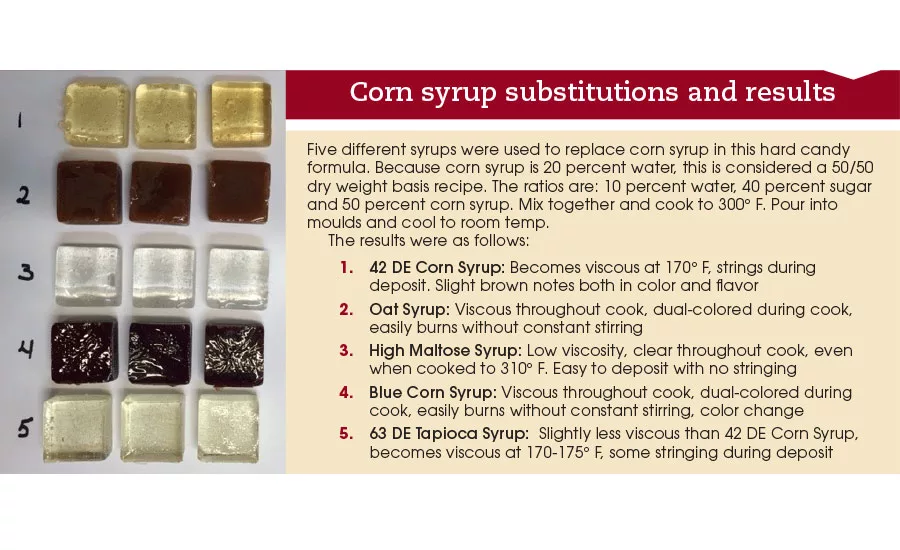
Corn syrup substitutions and results
Five different syrups were used to replace corn syrup in this hard candy formula. Because corn syrup is 20 percent water, this is considered a 50/50 dry weight basis recipe. The ratios are: 10 percent water, 40 percent sugar and 50 percent corn syrup. Mix together and cook to 300° F. Pour into moulds and cool to room temp.
The results were as follows:
- 42 DE Corn Syrup: Becomes viscous at 170° F, strings during deposit. Slight brown notes both in color and flavor
- Oat Syrup: Viscous throughout cook, dual-colored during cook, easily burns without constant stirring
- High Maltose Syrup: Low viscosity, clear throughout cook, even when cooked to 310° F. Easy to deposit with no stringing
- Blue Corn Syrup: Viscous throughout cook, dual-colored during cook, easily burns without constant stirring, color change
- 63 DE Tapioca Syrup: Slightly less viscous than 42 DE Corn Syrup, becomes viscous at 170-175° F, some stringing during deposit
Looking for a reprint of this article?
From high-res PDFs to custom plaques, order your copy today!