Safeguarding your sweets: Trademark protection tips
Attorneys specializing in intellectual property offer insights on trademark protection.

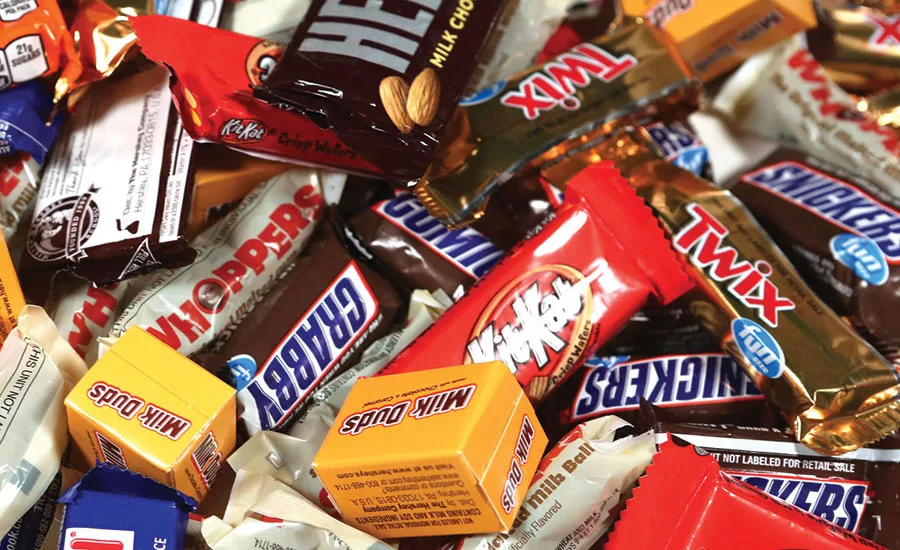

Trademark battles in the candy world have hit the headlines in recent days. Toblerone’s legendary trademark for the unique shape of its bars is being challenged by an upstart company in a European court, and the denial of KitKat’s U.K. trademark for its break-apart bar shape is the latest setback in the company’s seven-year legal battle. Do you know what you should about trademark law?
First, what is a trademark?
A trademark can be a word, phrase, logo, design, shape, color or virtually anything used to identify the source of a product and distinguish it from competitors’ products. More than one trademark may be used in connection with a product. For example, HERSHEY’S KISSES, SEALED WITH A HERSHEY’S KISS and are all trademarks for a specific candy.
Trademarks represent the goodwill and reputation of a product and its source. Its owner has the right to prevent others from trading on that goodwill by using the same or a similar trademark on the same or similar products in a way that is likely to cause confusion as to the source, origin or sponsorship of the products.
Not all trademarks created equal
There is a hierarchy of word marks, which exist on a spectrum of strength and protectability. At one end are arbitrary and fanciful marks, which are the strongest marks and are afforded the highest level of protection. At the other end of the spectrum are generic words, which are not protectable.
Fanciful marks are made-up words that have no real meaning and have been invented solely to function as a source-identifier. Examples are CLOROX for bleach, KODAK for film and EXXON for gas. Arbitrary marks are real words that are in common use, but have no meaning in connection with the goods and services to which they are applied. Examples are APPLE for computers, NERDS for candy, and CAMEL for cigarettes. Arbitrary and fanciful marks are afforded very strong protection.
Generic words name the goods or services. If a word answers the question “what are you?”, it is generic. Examples of generic words are CHERRY STOUT for cherry-flavored beer, MALT CHOCOLATE for chocolate with malt, or JELLY BEANS for jelly beans. Generic words have no trademark significance and are not entitled to any protection.
In between arbitrary/fanciful marks and generic marks are suggestive and descriptive marks. Suggestive marks are marks that suggest the goods and services to which they are applied, or the characteristics thereof. Examples are SWEETARTS for candy, ORANGE CRUSH for orange drinks and RED VINES for licorice. Suggestive marks are afforded strong protection.
Descriptive marks describe the goods and services to which they are applied, or a significant function, attribute, characteristic or property thereof. Examples are WINE BARREL ALE for beer made in wine barrels, and RAISIN-BRAN for raisin and bran cereal. Geographic and laudatory terms (BEST, GOOD, HIGH, etc.) often fall into the descriptive category. Descriptive marks are afforded weak protection and the owner must prove that consumers recognize the mark, or that they have “acquired secondary meaning,” before they can be registered or protected.
Selecting a strong brand name will save you time, money and energy. Marks in the higher end of the hierarchy are easier to register, and easier to protect.
Other types of trademarks
In addition to word marks, your candy products may include other types of trademarks, such as logos, slogans, flavor names, size designations, smells, sounds and colors.
The non-functional features of a product’s shape or packaging (its “trade dress”) may also be protectable if they are sufficiently distinctive. Examples of registered marks for product shape and packaging include the shape of a HERSHEY’S KISS chocolate, the triangular shape of Tobler’s Toblerone chocolate bar and the bean-shaped window used by Jelly Belly Candy Co. in its packaging.
While product packaging such as boxes or wrappers may be inherently distinctive, product configuration such as the shape of a HERSHEY’S KISS chocolate or the triangle shape of a Toblerone bar can never be inherently distinctive. As such, you will need to establish the trade dress has “acquired secondary meaning.”
If you wish to obtain trademark protection for product shape or packaging, you should promote the protectable features through “image” advertising or “look for” advertising so that customers recognize the product shape or packaging and associate it with a single source.
Conducting a search
Once you have selected your mark, it is a good idea to conduct clearance searching to make sure that your mark does not infringe the mark of another. At a minimum, you should check internet search engines and the online database of the U.S. Patent and Trademark Office (PTO). There are a number of professional search services that may be used for clearance searching.
The goal of such searches is to avoid investing time, effort and money promoting a mark, only to receive a cease-and-desist letter from another company informing you that you are infringing their rights.
Registering your marks
Once you have selected your marks and cleared them through a search, it is a good idea to register them with the PTO. An application for a federal registration may be filed before a mark is used in commerce, assuming the applicant has a good-faith intent to use the mark. Actual use must begin, however, before the registration will issue.
There is no requirement to register your mark, but there are many advantages to doing so. A federally registered mark is presumed to be valid and the registrant is presumed to have the exclusive right to use the trademark throughout the United States on the goods or services listed in the registration. A registered mark will also be revealed in searches conducted by other businesses in their effort to select marks that do not conflict with others. In addition, only federally registered trademarks or service marks may use the ® symbol.
Without these important benefits, your rights under the common law may be limited to the geographic areas where you have used the mark, and you would need to prove that you have a valid and protectable mark to enforce your rights. A federal registration can make enforcement much easier.
International expansion
You should consider whether you will be able to use the same branding in other countries. Conducting an international screening search at the time of developing a mark could help avoid unpleasant surprises in foreign countries.
It may be advisable to file trademark applications in other countries early to avoid others from pirating your brand. Foreign pirates may be able to prevent the original U.S. trademark owner from using or registering the mark in foreign countries. In some cases it may be possible to recover the mark, but the U.S. owner may face expensive litigation or exorbitant demands from the pirate.
In some cases, your U.S. branding/marks may not appeal to consumers in other countries. You may want to carefully consider the meaning and impression of marks in foreign languages before adopting them.
Conclusion
Trademark protection can be a very important tool in marketing and distinguishing your candy products from those of your competitors. Understanding your rights and the limits of your intellectual property protection is imperative. Having a strong game plan can ensure strong brand rights and good value for your legal expenditures.
Looking for a reprint of this article?
From high-res PDFs to custom plaques, order your copy today!