Food Safety
Undeclared allergens continue to trouble the chocolate sector
Many of the chocolate-related FDA recalls over the last year have been caused by undeclared allergens. But there are things manufacturers can do to prevent them.
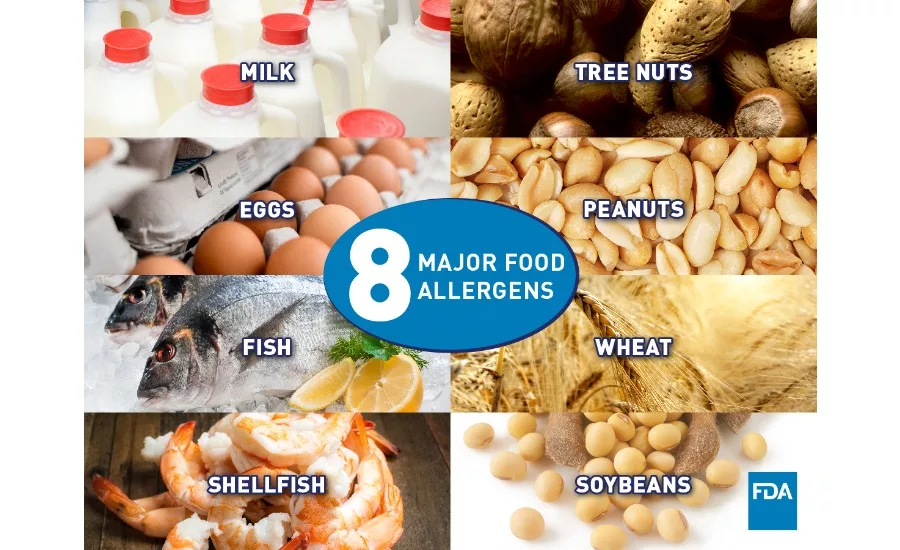
Eight foods are identified as major food allergens, as shown in this image from the U.S. FDA. Under the FASTER Act of 2021, sesame is being added as the ninth major food allergen effective Jan. 1, 2023.
Scan through the 2021 chocolate-related U.S. FDA food recalls, and you’ll see a common theme — undeclared allergens.
There’s the April 13, 2021 recall of the Torn & Glasser Dark Chocolate Espresso Beans because of undeclared walnut allergen.
The April 15, 2021 recall of Lake Champlain Chocolates' Mr. Goodtime Bunny for undeclared almonds.
The May 5, 2021 recall of Hershey's Chocolate Shell Topping due to undeclared almonds.
The June 23, 2021 recall of Trader Joe's Dark Chocolate Almond Butter Cups, because it may contain peanut protein.
It’s not a new problem. According to the most recent FDA data available, from 2009-2013, approximately 11 percent of food allergen-related entries in the Reportable Food Registry (RFR) were attributed to undeclared allergens in chocolates and other confections.
The FDA also says that candy, including chocolate, was among the top five food types involved in food allergen recalls, with the other four including: bakery products, snack foods, dairy products, and dressings.
“A number of commonly consumed foods are food allergens, and they are abundant in the food supply,” said Stefano Luccioli, M.D. in a recent FDA interview.
Luccioli explains that there are eight major food allergens — peanuts, shellfish, tree nuts, milk, eggs, fish, soy and wheat — and any ingredient derived from these foods is required to be identified on the label.
In addition, in April 2021, the Food Allergy Safety, Treatment, Education, and Research (FASTER) Act was signed into law, declaring sesame as the ninth major food allergen recognized by the United States. This change will become effective on Jan. 1, 2023.
“The eight major food allergens were selected because, at the time the Food Allergen Labeling and Consumer Protection Act of 2004 (FALCPA) was passed, they were responsible for 90 percent of food allergies and thus were the most common causes of severe food reactions in the United States,” Luccioli said. “But they didn’t then and don’t currently represent all foods worldwide that people are allergic to, which includes more than 160 foods. In some other countries, for example, mustard, lupin, and celery are also identified as priority allergens for labeling purposes.”
It can be challenging for manufacturers to navigate allergens — as evidenced by the chocolate sector’s allergen-related recalls over the last year.
“What the FDA has said is that if there is a possibility of allergen cross-contact, manufacturers should do everything possible to eliminate or significantly minimize this,” Luccioli said. “Voluntary allergen advisory statements, also known as precautionary allergen labeling, like ;may contain (allergen)' or 'produced in a facility with (allergen),' have been used by food manufacturers to alert consumers about the possible presence of allergens due to allergen cross-contact.”
But those statements are not meant to be an easy-out for manufacturers.
“The FDA has made clear that the advisory statement is not to be used instead of current good manufacturing practices (CGMPs). These are FDA regulations that require adequate control of allergen cross-contact. In other words, manufacturers cannot just place an advisory statement on a product without first taking measures to prevent allergen cross-contact to the best degree possible,” Luccioli said. “Under the Current Good Manufacturing Practice, Hazard Analysis, and Risk-Based Preventive Controls for Human Food rule, major food allergens are regarded as food hazards, and manufacturers are required to implement procedures, practices and processes when necessary to significantly minimize or prevent allergen cross-contact of major food allergens.”
In practice, that may include things like:
- Segregating allergens from non-allergens in the facility
- Scheduling products with allergens at the end of daily production cycles, when possible
- Sanitation and cleaning of equipment after processing products containing allergens.
Luccioli said the FDA continues to develop methods to detect and determine how much of an allergen is present in various food products and to gain greater capacity to test for a variety of allergens.
“For example, the FDA developed the xMAP food allergen detection assay that can simultaneously detect 16 allergens, including sesame, in a single analysis, with a design that allows for expansion to target additional food allergens,” he explained. “These advances will enhance FDA’s ability to monitor the food supply for undeclared allergens and take action when they are found.”
When the FDA does find an undeclared allergen, they review the situation on a case-by-case basis.
“A major food allergen is considered a serious potential hazard for the public. Thus, a product that is found to contain an undeclared major food allergen is likely to be subject to recall,” Luccioli said. “In some cases, the FDA may determine that a product containing foods or food ingredients that are not major food allergens could also pose an allergen hazard to public health if they are not properly declared as ingredients on the product label and may recommend regulatory action accordingly.”
In 2018 and 2019, the FDA conducted a survey to understand the extent to which dark chocolate bars and dark chocolate chips labeled as “dairy free” contained levels of milk that would be potentially hazardous to consumers with milk allergies.
Milk is the most common undeclared food allergen, responsible for more than a third of all food product recalls caused by undeclared allergens in the U.S. in the past decade, according to the FDA. And it also is the leading cause of consumer adverse reactions to foods recalled because of undeclared allergens.
To be eligible for inclusion in the assignment, products had to be manufactured in the U.S., bear a dairy-free or similar claim on their package or website, and consist solely of dark chocolate (e.g., be free of cream or nougat filling, a candy shell, or inclusions such as nuts, fruit, or seeds).
The agency found that four of the 52 products tested had potentially hazardous levels of milk allergen. They were made by three different manufacturers. Together, the four products were responsible for 12 positives out of the 119 samples.
After conducting the research, the FDA recalled all four products (i.e., dark chocolate bars) found to have potentially hazardous levels of milk allergen, namely those with detections from 600 ppm to 3,100 ppm. Two of the recalled products were manufactured by the same firm, resulting in three recall events in all.
At the time, the FDA concluded by saying:
“The presence of undeclared milk allergen in dark chocolate products with dairy-free claims remains a concern to the FDA in light of these FDA findings and the history of recalls caused by undeclared milk in dark chocolate products, including those labeled as dairy-free. The FDA plans to continue to research, evaluate, and monitor the issue, including targeted sampling of domestic and imported dark chocolate as warranted, and offers the following for the consideration of consumers and industry, respectively.”
The results show how difficult it is for companies to completely eliminating allergens, as well as how serious the FDA takes the issue. In the end, however, it's the consumers with serious allergies who have the most to lose.
Looking for a reprint of this article?
From high-res PDFs to custom plaques, order your copy today!