Ingredient Innovations
Vegan, clean label, and brilliant textures: How candy makers can benefit from pectin
As companies look for plant-based ingredients, and more cannabis gummies hit the market, pectin gains popularity.
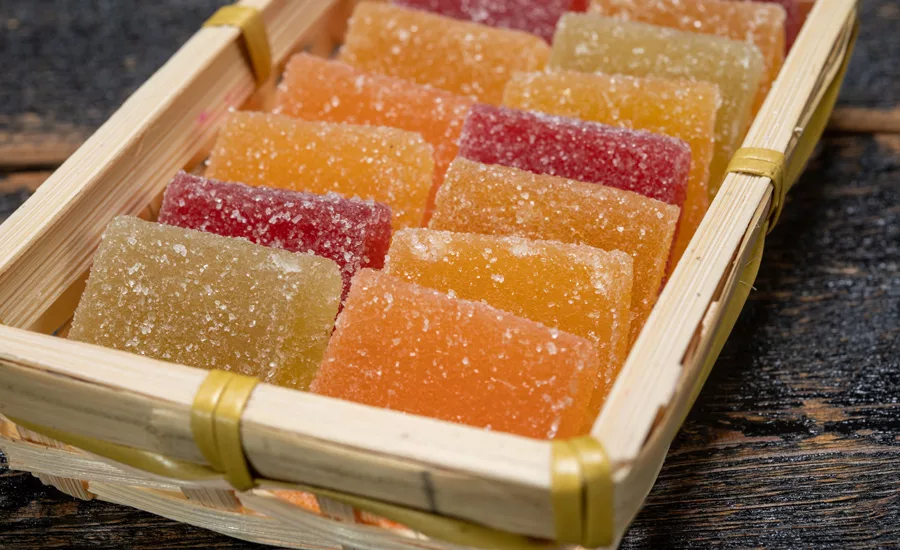
Last May, when Perfetti Van Melle USA, Inc. launched its first soft gummy products in the U.S. under the Fruit-tella brand, the company made sure to note one of the ingredients.
It wasn’t a specific flavor, a specific color, or even a specific sweetener, though — it was a gelling agent.
“Fruit-tella Soft Gummies have real fruit puree as the No. 1 ingredient and are made with pectin instead of gelatin,” the company said.
Yes, pectin.
It’s not historically one of the most flashy ingredients in candy, but as consumers move to more plant-based and health-conscious diets, they have also started paying attention to what is holding their gummy candy together.
So what is pectin?
Iliana Nava, senior technical service specialist, hydrocolloids, Cargill, explains that it’s a natural compound found in plants, and it is especially abundant in apples pomace and citrus peels.
“In confectionery applications, pectin is often used in classic gelling applications such as gummies and chews,” she said. “In these confectionery formulas, developers rely on pectin to provide structure and syneresis control. It’s also known for its clean flavor release and short bite.”
Pectin is definitely having a moment. A recent IMARC Group report, “Pectin Market: Global Industry Trends, Share, Size, Growth, Opportunity and Forecast 2020-2025,” finds that the global pectin market has grown at a CAGR of 5.7 percent between 2014-2019. As for the forecast, the report predicts that the global pectin market will exhibit moderate growth during the next five years.
In fact, Cargill has seen such an increased demand for pectin that the company is opening a new, state-of-the-art pectin processing facility in the heart of Brazil’s citrus region later this year. That facility will be in addition to the company’s three pectin production facilities in Europe.
“This will not only significantly increase our pectin supply, but it will also spread our production across two continents,” Neva said.
Plant-based eating increases demand for pectin to replace gelatin
In candy, pectin is commonly used to replace gelatin, which is made from animal products. And the growing popularity of plant-based diets has meant a growing popularity for candy made with pectin instead.
“The momentum behind plant-based eating continues to be a top trend, extending into the confectionery space,” Nava said. “Here, it’s gelatin that’s under fire, as consumers seek to avoid animal-sourced products. While gelatin was once the go-to ingredient for gummies, jellies and other chewy candies, confectioners are increasingly turning to pectin in these applications.”
Although some shoppers may not initially associate pectin with candy, it’s long been used to make another product at home.
“Plant-sourced pectin is a long-standing consumer favorite, one that many shoppers associate with their grandma’s homemade jams and jellies,” Nava said. “Like gelatin, pectin is an exceptional gelling agent, but it offers its own unique organoleptic properties.”
Gelatin and pectin also offer different end results.
“Where gelatin combines a tough first bite with an elastic, highly chewable texture, with pectin, you get a much cleaner, shorter bite, with little chewiness or elasticity,” Nava explained.
Pectin also comes with a higher melting point than gelatin, which also can make a big difference in certain regions.
“This is especially noticeable in warmer climates, where pectin-based gummies will resist melting and resolidifying in transport and storage,” Nava said.
Candy makers specifically looking to create a plant-based recipe should look to pectin as the first choice.
“Vegetarian gummies already have the right conditions of solids and pH for pectin to form a gel and provide appealing textures to consumers,” Nava said. “This makes it an ingredient to be considered right away, from the initial stages of formulation development. In addition, due to its plant-based origin, pectin is a great label-friendly option and it is easily recognizable to consumers.”
And given its citrus/fruit origins, pectin pairs well with fruit flavors.
“It has a clean flavor, and the high methoxyl (HM) pectin used for candies requires acidification to set, which can also help with the flavor delivery of the candy,” Nava said. “From a processing standpoint, some pectin variations can set rapidly, making the use of reusable molds (non-starch based) high feasible.”
Growing cannabis looks to pectin
It’s not just plant-based diets growing the need for pectin. Increased consumer interest in gummy products made with CBD, THC and other botanical ingredients has also accelerated the demand for the pectin.
Neva said these gummy products are a great space for pectin as they tend to be vegan/vegetarian friendly.
“For these customers, it is critical to understand the texture they want to achieve. Other considerations include determining when to incorporate the botanical additives in the process and how these ingredients may affect the gelling time of the finished product,” she explained. “It is also imperative that as more of these small companies adopt reusable molds for cost and cleanliness reasons, they make sure their pectin sets within the time frame needed to extract the products from the molds.”
Ultimately, to create the pectin-based product manufacturers desire, it’s important to consider the type of pectin, how it is buffered, the time needed for pectin to set, the amount of solids and the pH.
During a 2019 PMCA forum, Michelle Frame, founder and president of Victus Ars, said pectin offers specific advantages for cannabis-infused gummies. It provides a translucent visual and a softer chew, compared to gelatin, which offers stiffness.
In February, 3Chi gummies announced the release of an improved version of their Delta-8-THC gummies. The company specifically noted that it was using a softer pectin-based formula that breaks down quicker to aid in absorption of the Delta-8.
And in November, CBD Living launched its new Vegan PM Gummies, which are made with tapioca syrup and pectin instead of animal-based gelatin.
“Our Sleep Aid Syrups were one of the first products we introduced back in 2014 and are still incredibly popular,” said CBD Living COO Sean McDonald. “However, we wanted to offer another delicious, convenient — and low-sugar — way that our customers could achieve a deep, restful sleep and we are thrilled to introduce our new Vegan PM Gummies.”
How to use pectin in candy formulations
Once candy makers decide to use pectin, they need to make sure they choose the right one.
“We use high methoxyl (HM) pectins in most confectionery applications,” Nava said. “HM pectins need a high solids content (greater than 60 percent) and a low pH (2.8-3.5) to form a gel. These are critical things to watch in gummies and other confectionery products. Without them, you will have a soft product.”
Depending on their degree of esterification, they can be classified as slow set, medium rapid set and rapid set. The higher the degree of esterification, the higher the setting temperature. This is important to keep in mind to avoid obstruction of equipment used to deposit gummies.
Candy makers also should factor in other variables, such as the use of starch versus reusable non-starch molds and how quickly the gummies will be removed.
Nava explained that when working with pectin, it works best to create a pectin pre-solution.
“Start by dispersing pectin with another dispersion aid in your formula, such as sugar or dextrose,” she said. “Then add the dispersed pectin into ambient water under agitation in your pre-solution tank. Heat and hold for 15-20 minutes under agitation to activate the pectin. Once this step is complete, the hot pectin solution is ready to add to the remainder of your recipe.”
For those switching to pectin from another hydrocolloid, Nava said it’s important to understand the textural similarities that they may share and to consider doing partial replacements initially.
“If a partial replacement is considered, make sure to assess the pH and overall processing of the finished product to assure all functional parts of the system are fully activated,” Nava said.
Of course, if needed, Cargill’s confectionery development experts can also help manufacturers looking to either create new products made with pectin or to switch to pectin in existing products.
“Typically, high methoxyl pectin is used in fruit-flavored products, where the acidity enhances many fruit flavors. However, when incorporating better-for-you ingredients that are sensitive to acidic pH, Cargill’s low methoxyl pectin is the answer,” Nava said. “Low methoxyl pectin can be used in a wider pH range, offering a solution when an acid-sensitive functional ingredient such as inulin needs to be incorporated into a gummy candy.”
Looking for a reprint of this article?
From high-res PDFs to custom plaques, order your copy today!