Japanese pastry chef Sadaharu Aoki's push for simplicity
Secrets of success rooted in French traditions.

Office workers from nearby buildings take a good look at the available macaron varieties.
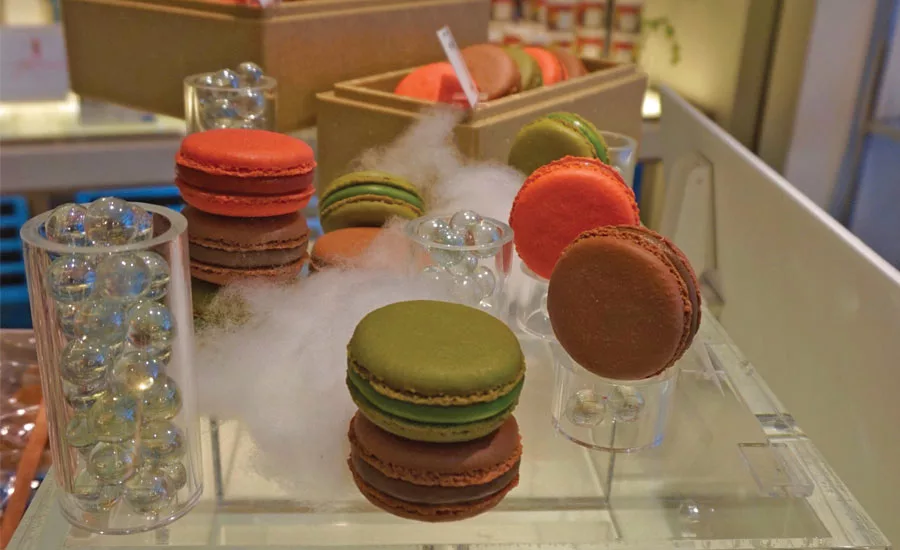
Display and artistry place a key role in enticing Japanese consumers.


Staff inside the Marunouchi store ensure the assortment looks spotless.

For the finishing touch, the composition is everything for this patissier.


Japanese cuisine is famous for its amazing rice dishes, sushi and ramen. Less known, however, is the Japanese fascination with desserts, especially when it comes to confections and pastries.
Many Japanese pastry chefs received their education in France, learning the basics before bringing it back to the homeland and “Japanizing” the pastries. Candy Industry followed one chef who’s part of Sadaharu Aoki’s pastry imperium for a day to see the Japanese style in action.
It was nearly 15 years ago when Japanese pastry-maker Sadaharu Aoki packed his suitcase to leave for Paris, a grudging self-realization that the capital of pastries and confections wasn’t going to come to him.
Despite some trepidation, it was quite logical to move to the French capital, as there is probably no other place in the world where one can view and learn the art from some of the world’s most skilled pastry chefs. In hindsight, it was a brilliant idea: Aoki managed to build up what one can safely call a pastry imperium. He has four stores in Tokyo, four in Paris and two in Tapei.
Throughout his career, Aoki always answered the fundamental question, “What does he attribute his success in building such imperium?” with one word: simplicity.
“I love to create simple things, but that is probably the most difficult aspect of making simple products – especially confections, as simple and straightforward products can’t be manipulated,” he says.
Obviously, it not only takes talent but extensive training to make that one product perfect in many different respects. Being in France for most of his career helped Aoki, since it meant he could work with quality products – surrounded by people with the knowledge about, and the passion for, making the world’s best desserts.
To fully understand the philosophy of Japanese pastries, and the Japanese approach to confections in general, Candy Industry decided to visit the headquarters of Sadaharu Aoki, in the southern part of Tokyo. The boss Aoki was not present, as he spends most of his days in Paris, but his prodigy — pastry chef Tashiro Naoya — took his time to show the press around in the kitchen, where most of the pastries for the four shops in Tokyo are made.
Impeccable ingredients
For almost three years, Naoya has worked as one of the main chefs of the Tokyo branches. Hygiene is a big priority for Naoya, which becomes clear when he conducts a tour through the kitchen. The pastry chefs need to go through what we could describe as a “clean room” to get from the office area to the actual kitchen. The tiny room is closed off from the outside and blows off all dust and possible bacteria from employees’ clothes.
Upon entering the kitchen, we’re greeted with bows, a sign of typical Japanese hospitality known as omotenashi. Yet, there isn’t much time for small talk; one of the employees is busy finishing a cherry pie, experimenting with a wide variety of different ingredients.
On a big, silver-looking plate we find the ingredients: almond flour, oranges and — obviously — some fresh cherries. She mixes them aggressively and when asked about what the other ingredients are, she can’t deny a cheeky laugh: “For now that’s top secret.”
Naoya explains the pastry market is starting to become very competitive, also in Japan. It means they need to experiment with different products to satisfy a growing group of consumers.
Not very far from the female employee, Naoya’s eyes catch a big chunk of butter, which he places back into the refrigerator.
“This is Echiré butter, coming from the west of France,” he explains. For pastry chefs like Naoya it is crucial to work with only top-quality products, and the butter is possibly the most crucial ingredients. “In France, you’ll find the best butter, it is simply the best, you can recognize it because it will smell like yogurt; in Japan we don’t have this kind of quality.”
Japan’s reliance on foreign products, however, does have a downside, Naoya explains: “There are very strict laws we need to abide by for certain foods that are imported from abroad, which makes the import-process a slow one and doesn’t benefit the freshness of the products.”
[Editor’s Note: Japan recently signed a trade deal — The EU-Japan Partnership Agreement — with the European Union that eliminates an existing tariff on hard cheeses and other dairy products. This should increase availability to more premium dairy items as well as lower costs and improve shipping times.]
Just like most of the pastry chefs working for Aoki, Naoya studied at the Tsuji Institute of Patisserie, a two-year educational program for pastry chefs. Most of the students eventually move to a Japanese sister school in France, where they receive the final part of their education.
In Annecy, a little border town between France and Switzerland, Naoya learned the basics of the pastry profession. “Here we learned about the ingredients, but also about taste and texture. For instance, we learned when to use certain products, like egg whites, which are better not to use in the summer when it’s too humid.”
On the right side of Naoya, a colleague is preparing a chocolate cake that will be transported to the four stores at the end of the day. As he cuts the cake into equal parts with a measuring stick, he explains: “When you make this type of cake it is crucial not to leave any space between the cake layer and the chocolate filling to prevent the cake from becoming chunky, which will give it a dry structure. You need to practice a lot to get it right.”
And this is exactly what Naoya and his Japanese colleagues did in France. After he finished six months at the school in Annecy, he got the chance to work for Aoki’s Paris shop. This is where he was introduced to Aoki’s philosophy – simple yet high-quality, high-end pastries. But what are the differences between Japanese and Western pastry chefs?
He points at another colleague, who is busy measuring a roll cake. “The Japanese pastry chef usually makes much lighter desserts, which is why Japanese consumers love roll cakes and shortcakes,” he says.
A review of Japanese supermarket pastry departments and convenience stores confirms the trend; most of what they sell consists of airy shortcakes. “The smaller the portion the better – as long as you get the taste right,” Naoya explains.
For him, however, macarons remain Naoya’s favorite.
“It is a very simple dessert, in line with Aoki’s philosophy,” he points out. “It consists of three ingredients: almond flour, egg whites and, of course, sugar. A straightforward pastry, and seemingly easy to make at first sight. Yet, it is surprising how difficult it is to get it right, to make a high-quality macaron. Again, you’ll often see pastries having too much air in between the various ingredients, which is not good for the taste, or making it too sugary.”
The Japanese touch
After Naoya’s crew put the finishing touches on the pastries, we decide to visit one of the stores in Tokyo, in Marunouchi. It is 6 p.m. and the shop is filled with well-dressed office workers who definitely have a sweet tooth.
The most popular pastry is the French macaron; it’s anywhere you look. It seems to be the central theme throughout the shop.
Yet, there is a very important difference: all the products have a specific Japanese flavor added to them. For instance, macarons are flavored with matcha powder. This is pastry chef Naoya’s favorite ingredient, and represents the very essence of Japan’s DNA.
He points at an éclair with a green color – also matcha. “This matcha powder comes from Kyoto,” Naoya explains.
Traditionally matcha is mainly used for tea, for instance, in sushi restaurants. But these days it is starting to gain popularity as an ingredient for confections. Interestingly, some of the most popular confectioners that are exported to the West contain matcha — Kit Kat chocolates with matcha being one of the most popular.
As you can see, Naoya explains, the prices are relatively high. “But this is the philosophy of our boss Aoki: he only wants the highest quality of ingredients, so this is what you pay for, and Japanese consumers want to pay for quality.”
Be it butter, flour, sugar, chocolate, matcha, or fruits, Japan consumers don’t go for quantity, they are happy to get a smaller piece, if the quality is guaranteed.
“This may sound like a cliché, but in fact you will see it with all types of confections — size is always of lesser importance. On top of that, desserts are full of calories, so it doesn’t have to be so big, right?” Naoya concludes.
Small perhaps, but simply delicious.
Looking for a reprint of this article?
From high-res PDFs to custom plaques, order your copy today!