Starches continue in multifunctional role as consumer demand for clean-label products grow
Demand for organic, non-GMO, gelatin-free products stimulate specific applications for range of starches.
Starches continue to grow as consumer demands for organic, non-GMO and gelatin-free products.
Starches continue to grow as consumer demands for organic, non-GMO and gelatin-free products.
Starches continue to grow as consumer demands for organic, non-GMO and gelatin-free products.
Starches continue to grow as consumer demands for organic, non-GMO and gelatin-free products.
Starches continue to grow as consumer demands for organic, non-GMO and gelatin-free products.
Its multifunctional role continues to grow as consumer demands for organic, non-GMO and gelatin-free products stimulate specific applications for a greater range of starches.
“The most pure and white starch is made of the rootes of the Cuckoo-pint, but most hurtful for the hands of the laundresse that have the handling of it, for it chappeth, blistereth, and maketh the hands rough and rugged and withall smarting.”
— Gerard's Herbal, 1633, from www.Oldandinteresting.com
Candy makers need not worry about “chappeth, blistereth” and rough, rugged hands when they work with starch. As Ingredion’s Jackie LaFleur, technologist- technical services, explains, both unmodified and modified starches can play a variety of roles in confectionery formulation and processing. Moreover, none of them will cause your hands to smart or blister.
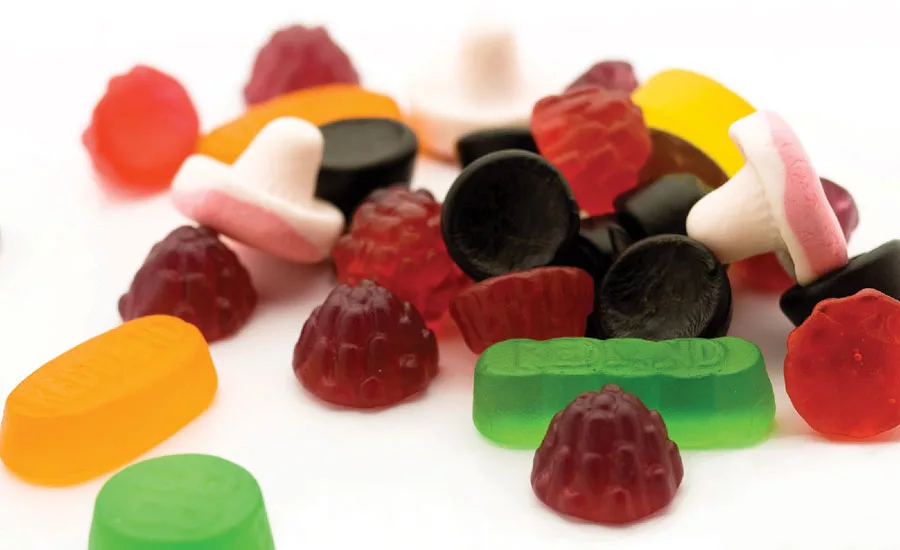
As she points out, confectionery starches can act as a sole gelling agent in a jelly-type candy (i.e. fruit slices, gum drops, jelly bean centers); a complementary gelling agent in combination with gelatin, pectin, or other hydrocolloids; a moulding medium used for depositing candies when native/unmodified corn starch is combined with a small amount of mineral oil or high stability vegetable oil; a texture modifier and stabilizer in chewy-type candies; a film former in pan-coated confections; an external dusting agent for marshmallows and other confections to prevent sticking, etc.
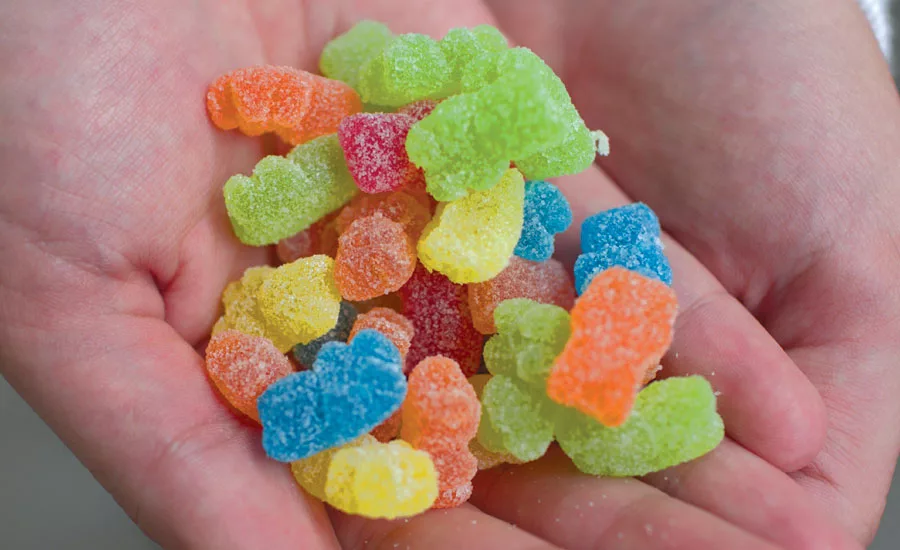
When it comes to producing jelly and gummy candies, LaFleur points out that a certain type of modified starch (that is the “thin-boiling” variety) is almost exclusively used. This modified starch allows for the high-solids candy slurry to be processed at a viscosity low enough to deposit easily (without tailing) when hot, but still allows for a strong starch gel to form when the slurry cools.
“While chemically modified starches have been used widely and successfully in the confectionery industry for many, many years, there is now a push to market confectionery offerings as ‘natural’ or both ‘natural and organic,’” she says. “Although the FDA has not clearly defined what ‘natural’ means, it is more or less commonly accepted that ‘Food Starch-Modified’ is not a clean label product. Modified starches additionally cannot be used in organic products.”
Cargill’s Michelle Kozora, technical services manager, Cargill Texturizing Solutions, concurs.
“Consumer demand for clean label products has caused some food manufacturers to reconsider their use of modified food starch,” she says. ”To help manufacturers reach their goals, Cargill’s food scientists are developing ways to replace modified food starches with native starches obtained from sources such as corn, wheat, potato, cassava and tapioca. In particular, native starches are very good as a dusting agent or moulding starch in confectionery applications.”
LaFleur also notes that Ingredion has many clean-label and several organic starch options for use in confectionery.
“However, it can be challenging to duplicate the very low hot viscosity and ease of depositing that the modified thin-boiling starches provide,” she explains. “This presents a major challenge for manufacturers making deposited candies that have a ‘natural’ and/or ‘organic’ claim, and forces them to get creative with a limited amount of natural and/or organic gelling starch and hydrocolloid options that also give a low, manageable hot viscosity.”
LaFleur says that using these ingredients requires a balance of usage rates and the utilization of starch bases that have a high enough amylose (the gelling polymer in starches) content to form a firmly gelled confection.
Starches may also play a role in replacing gelatin, Kozora says. “Gelatin comes from animal sources, a fact that has some of our customers looking for alternatives. We have not yet seen a native starch that can replace gelatin used in confectionery applications alone. However, we have had some success using small amounts of tapioca starch in combination with ingredients such as pectin and agar agar to develop a gel in sugar confections.”
Helma Slierendrecht, senior technical sales manager, North America, for KMC, who gave a presentation on “The Use of Modified Potato Starches to Formulate Gummy Candy with Partial or Complete Gelatin Replacement” at Prepared Foods Magazine’s R&D Applications Seminar in Chicagoland earlier this month, says the phenomenal growth of gummy candies during the past 10 years has coincided with an increased interest in vegetable-based formulations, which forego the use of gelatin derived from pork or beef.
Costs also come into play, as partial replacement of gelatin with starches can work favorably in reducing manufacturing outlays.
“Potato starch has several qualities that work well in this regard [gelatin replacement],” she says. “It has low gelatinization, it’s non-GMO, neutral in color and good clarity,” Slierendrecht says.
It does require some adjustments in processing, she admits. Foremost is the need to adjust the drying process. Typically, partial replacement of gelatin with starch adds drying time to the process.
For example, in a 7 percent gelatin formulation, it will take 3 percent of potato starch to replace 1.5 percent gelatin.
“There’s no noticeable difference in such a replacement,” she says.
When the formula calls for replacing 3 percent of the gelatin with potato starch, the percentage for potato starch climbs to 7 percent. Here, the gummies could prove to be sticker than the gelatin.
“A complete replacement of gelatin with potato starch will give you stickier, less elastic gummies,” she says. To facilitate customer requests, Denmark-based KMC has an applications center with a jelly cooker and starch mogul to conduct trials using potato starch.
Along with non-GMO and gelatin replacement trends, there’s growing demand for gummies and jellies containing “actives” or functional ingredients that deliver vitamins, help control weight and deliver other specific benefits.
Here, too, starches can a play a role, LaFleur says.
“Starches are frequently employed in functional or nutraceutical candies. Functional ingredients often provide opacity when added to a confection,” she says. “As starches create an opaque starch jelly or gummy, they can be an economic gelling agent to use in this segment as the clarity typically associated with a gelatin-based gummy is compromised by the functional ingredients.”
Starches have an additional benefit in extending the shelf-life of functional candies, LaFleur points out. A product such as a vitamin gummy, where the consumer is typically ingesting one piece per day, needs to maintain its structure over a longer period of time than a typical confection where the package might be consumed in one sitting, she explains.
“Consequently, thermal stability of these products can be very important,” she says. “Starch forms an irreversible gel, compared to gelatin which melts at 95°F, and can thus improve the thermal stability of the functional candy.”
But it doesn’t end there.
“Starches can additionally be used for encapsulation, or as a flavor or functional ingredient carrier,” LaFleur says. “These can be natural-based specialty ingredients that enable customers to deliver oil-based actives with novelty, efficiency and consumer friendliness.”
Looking for a reprint of this article?
From high-res PDFs to custom plaques, order your copy today!