Colors play a role in push for all-natural confections
Natural colors have more functions than tinting a treat.
Color. Is it something confectioners take for granted? How can that be, you ask? After all, the range of products in the confectionery industry must be the most colorful in any food segment. There’s no lack of color, for sure.
But perhaps there could be a bit more creativity. Consider Beth Jackson Klosterboer’s Hungry Happenings website, where the food blogger and former candy store retailer — she operated BJaiz Yum Yum Shoppe in Louisville, Ky. and Candy Garden Handmade Chocolates in Dayton, Ohio — creates new food product ideas to share with her audience.
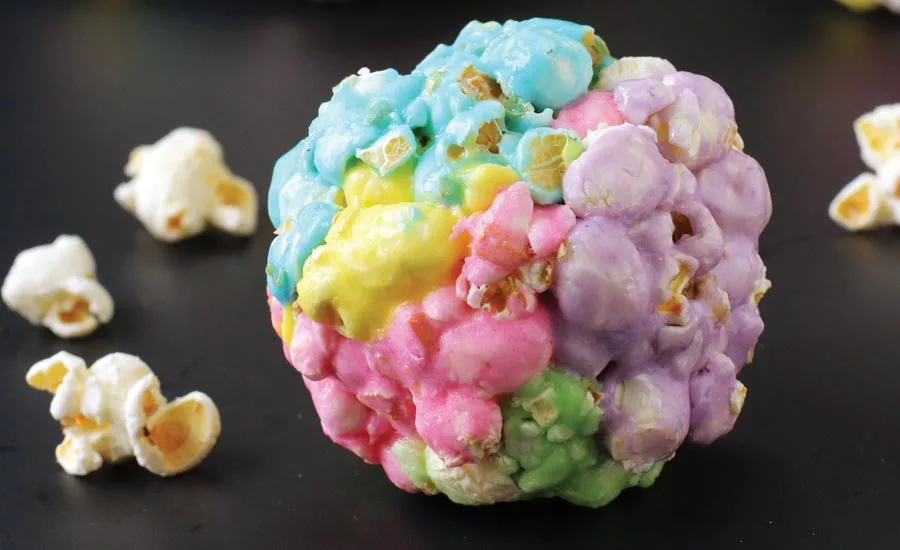
Her April 3, 2017, blog featured a recipe on how to create an eye-opening, Easter-themed Peeps Popcorn Ball, one that features all the colors of the rainbow. As Klosterboer writes, “Just grab a variety of colored marshmallow Peeps, melt them with some butter, stir in popcorn, and have fun creating a bunch of multi-colored popcorn balls. It’s as easy as that.”
In a few quick steps, the ubiquitous popcorn ball turned into a unicorn-colored treat that said “Wow!” (For specific details on the recipe, go to www.hungry happenings.com).
It’s important to remember that, as a Sensient Colors’ website points out, colors perform a variety of functions beyond the obvious visual connection.
Consider these bullet points:
-
Color Connects the Consumer to Causes and Community
-
Color Provides Consumer Health Benefits
-
Color Promotes Seasons and Holidays
-
Color Portrays Value and Lifestyle
-
Color Reveals Flavor
-
Color Indicates Quality
At the same time, ponder this factoid:
According to Sensient Consumer Research, 88 percent of consumers would be more likely to buy confectionery brands that have removed artificial colors. During the fourth quarter last year, the United States actually hit an all-time high with 73 percent of new products launched using natural colors.
But were it so easy. As David Dukes, president of IFC Solutions points out, “The vast majority of the colors we produce for our confectionery customers are still made from FD&C colors. Higher costs, shorter shelf lives, problems with heat and pH, and reduced color options are the primary reasons more candy products are not produced with natural colors. However, the fact that more and more large food and confectionery companies have committed to making the shift to natural colors is really starting to have an impact industry wide.”
So yes, it’s definitely happening. But not everything is instant. As Dukes relates, sometimes it takes years for companies to actually make the switch, which can cause problems.
“It is not all that unusual for a company to have samples of natural colors sitting in their lab for years before they try them in one of their products,” he says. “Samples of the company’s products are made using expired colors and approved by their customers. And then, when they buy fresh color, they are disappointed that it does not match the shade of the four-year-old sample that was in their lab.”
As a result, the company has instituted a fresh sample policy to prevent such dated applications. But fresh samples only represent one of the challenges confectionery companies faced in switching from artificial to natural colors. Stability is an issue.
“We have found success improving color stability by blending multiple natural colors from different sources into our natural color blends,” Dukes says. “This allows us to take advantage of the positive characteristics of each color.
“For example, we can produce a proprietary color blend using turmeric from three different suppliers. One turmeric might have the requested supplier color. Another might have better light stability. A third might have better solubility. By blending them all together, we can achieve a unique colorant with superior characteristics. Yet the label will still say ‘turmeric.’ And the customer will have a truly unique color with the best characteristics of each supplier’s color.”
The commitment by many major multinational food and confectionery companies to use natural colors has prompted more companies to experiment with “natural ingredients that impart color, but which are not approved as food colorants by the FDA,” Dukes says. This concept requires careful consideration as to whether it is appropriate for a specific ingredient to be used in a particular product.
“For example, if spinach (which is not an approved food colorant in the United States) is added to a soup mix with the goal of making it more of a green shade, the claim could probably be made that the spinach was added for its flavor or nutritional profile,” he explains. “A reasonable argument might be made that the ‘green’ shade of the spinach is secondary. Thus, the spinach could conceivably be considered a ‘natural’ ingredient in the soup mix, and labeled as a regular ingredient. Of course, this concept would need to have very careful scrutiny by a company’s regulatory department.
“On the flip side, a candy company making a lime green lollipop would have a tough time defending the presence of spinach in their product for anything other than color.”
Then there are application issues. And as Gale Meyers, manager at Sensient Food Colors NA, points out, a large percentage of natural colors are affected by pH.
“An anthocyanin can range in shade from a bright pink/red to a green shade simply by modifying the pH,” she explains on the company’s website. “Therefore, if the pH of the coating syrup is not monitored for consistency, shade variation will be an issue.
“Certain natural colors are sensitive to heat. Beet, for example, will degrade or turn brown with exposure to high heat. In some processes, it has been determined that beet can tolerate a temperature of 80˚C for two hours. Beyond this temperature, the color begins to degrade.”
And what about titanium dioxide, an FDA-approved colorant that imparts a “white” color, but one that has raised concerns by public interest groups? As Steve Morris, Sensient Food Colors NA general manager writes, “While regulatory bodies like EFSA have concluded the safety of food grade titanium dioxide, there continues to be criticism from activist groups like the French National Institute for Agricultural Research (INRA) and As You Sow in the United States. A recent study in Europe has led to a new review by French regulatory authorities.
“Unlike the ultrafine titanium dioxide used in some industrial applications, food grade TiO2 does not contain nanomaterial. However, there continues to be some public confusion between food and non-food grade versions. Due to the confusion and negative publicity, it’s not surprising some brands have initiatives to seek other options.”
Fortunately, suppliers are responding with natural white alternative colorants.
Finally, there’s the use of caramel as a color. Again, concerns about its use stems from Prop 65 in California, which requires labeling an ingredient as cancer-causing if studies show it to be so. James Smith of Brian Cave LLP on the Lexology website writes that 4-methylimidazole, or 4-MeI, is formed as a byproduct in some foods and beverages as part of the cooking process. It also forms in trace amounts when manufacturing certain types of caramel coloring frequently used in some dark beverages, such as cola and dark beer.
Concern about the caramel colorant first arose after a 2007 study by the National Toxology Program citing an increase rate of lung tumors in mice. Of course, the human equivalent of Mel-4 consumption was about 300 cans of soda daily for two years. A Consumer Reports article in 2014 stoked the controversy saying that some popular soft drinks contained MeI-4 levels above levels set by the California Office of Health Hazard Assessment (“COHHA”) under Proposition 6.
Since then, the issue has been in the courts. Hence, the concern by manufacturers, and once again, the move by color suppliers to offer up alternatives.
One thing’s certainly clear, transparency in color choices is critical.
Looking for a reprint of this article?
From high-res PDFs to custom plaques, order your copy today!