Report: Sustainability initiatives will fail until companies pay more for cocoa
Problems include child labor, gender inequality, infant malnutrition, and more.
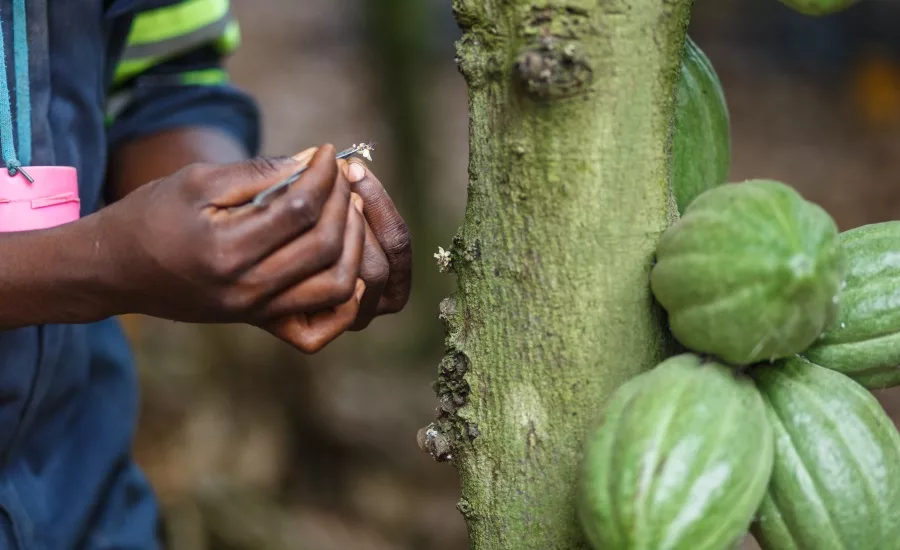
Endemic sustainability issues within global cocoa supply chains, including child labor and deforestation, will continue unless efforts are coupled with the payment of a higher farmgate price for cocoa, according to the 2022 Cocoa Barometer. The report finds that a combination of public policies, private sector purchasing practices, and agricultural solutions are needed.
The Barometer—developed by the VOICE Network of civil society organizations—shows that there remains a wide range of problems facing families in cocoa communities, including child labor; gender inequality; (infant) malnutrition; lack of access to education; insufficient health care facilities and sanitation; and a variety of labor rights violations for smallholders, workers, and tenants. Environmental issues such as deforestation and climate change remain a growing concern.
Without a significant increase in earnings, cocoa farmers will be burdened with the responsibility for addressing this range of issues without the means or incentives to do so. As such, environmental and social harms are likely to continue in the world’s major cocoa producing countries Ghana and Côte d’Ivoire. Top-down national and international government strategies aimed at increasing cocoa production to address poverty tend to support the chocolate industry while failing to address these issues.
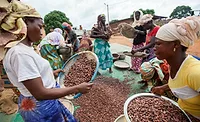
Additionally, the cost-of-living crisis is putting further pressure on farmers in West Africa. “In the past, after selling my cocoa beans, I used to plan my expenses and charges for my household, but this is becoming very difficult now. Prices of products are far beyond my provisions. I have children to care about and I‘m struggling to pay their school fees,” said Yao Kouame Martia of the cocoa cooperative ECAM in the south-west of Côte d’Ivoire.
Other measures ineffective in isolation
New data and models launched with this Barometer confirm that development measures aimed at increasing productivity and diversification will be ultimately ineffective without real efforts to close the living income gap through higher farmgate prices. Likewise, development programs alone are incapable of reducing deforestation, the use of hazardous pesticides or entrenching the long-term adoption of good agricultural practices.
Despite this evidence, most cocoa-purchasing companies continue to operate business as usual, supporting development programs while refusing to directly address their own purchasing practices—including pricing. “The one thing that affects us farmers is the pricing of cocoa beans. In fact, pricing is a disincentive to cocoa farmers,” said Hayford Duodu, a cocoa farmer in Ghana.
“Raising productivity or increasing farm size will never work in isolation to address the myriad of problems in the global cocoa supply chain,” stated Antonie Fountain, director of the VOICE Network. “Paying a higher price is inevitable if the living income gap is to be closed. Interventions such as the Ivorian-Ghanaian Living Income Differential are necessary first steps, but companies need to go far beyond that to ensure the farmgate price goes up.”
The Barometer suggests that colonial-era dynamics in cocoa supply chains, which saw vast wealth extracted from cocoa producing regions, continue to influence corporate and political attitudes to the problem, with the wealth generated in consuming countries through cocoa, still dwarfing investments in development programs. To address this imbalance, autonomous farmer organizations such as cooperatives need to be strengthened and supported by national and local government initiatives in producing countries.
Action needed on three fronts
The Barometer concludes that, in order for living income to become a reality for cocoa farmers, action is needed on three separate fronts: good governance policies by public bodies; good purchasing practices by the private sector; and good agricultural practices by farmers. For the past two decades, however, almost all of the cocoa sector efforts have been focused on farmers themselves, sidestepping the necessary changes in government policy and purchasing practices needed to tackle sustainability issues.
In this context, recent efforts by the EU to establish "due diligence" directives aimed at curbing environmental and social harms in global supply chains, including cocoa, are a welcome first step towards creating a more transparent supply chain. This is essential for keeping companies accountable for their purchasing practices. Ultimately even these positive policy developments will come to nothing if companies do not take action soon: they need to pay a higher price.
To read the full Barometer, or see the full list of recommendations for governments, corporations and farmers, visit cocoabarometer.org.
Looking for a reprint of this article?
From high-res PDFs to custom plaques, order your copy today!