Fairtrade launches map to identify human rights, environmental risks for major commodities
Risk map covers coffee, cocoa, honey, and more.
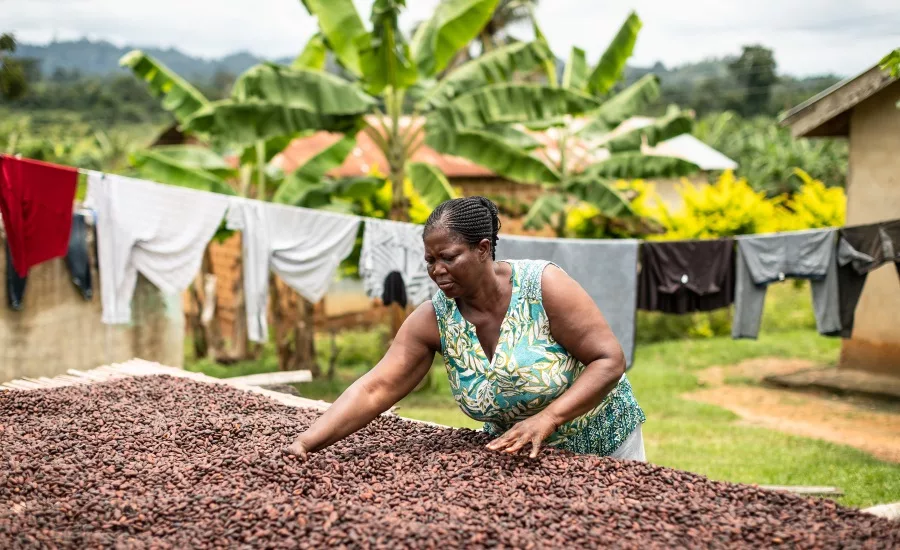
credit: Chris Terry
Fairtrade has launched a new risk map to identify and visualize the greatest human rights and environmental risks in the sectors where it is active. Human rights violations and environmental harm are widespread in global supply chains. One in five workers globally lives in poverty, agricultural production is responsible for 70 percent of freshwater withdrawals across the world, and child labor is increasing.
Currently the risk map covers coffee, cocoa, bananas, wine grapes, and honey, as well as the most common countries of origin of these products. More products will be added in the coming months.
The catalogued risks are relevant for the products and their associated growing regions for any supply chains, not only for Fairtrade, so that anyone—from farmers and worker organizations to brands to NGOs—can hone in on salient risks to communities and in supply chains. This comes as companies face growing legal obligations to carry out such risk assessments and to prevent, mitigate and remediate the greatest risks in their supply chains.
A product of Fairtrade’s ongoing risk and impact assessment work, the map adds value by incorporating rightsholders’ input collected through dialogue and participatory processes: Fairtrade spent several months working with farmer cooperatives, workers and plantation management, Fairtrade staff from six continents, and external experts to develop the map.
The website also includes detailed information on specific risk issues identified in the covered commodities, such as child labor, gender rights and living income, as well as environmental risks related to climate change, water, and biodiversity.
Marike de Peña, president of the Fairtrade Producer Network for Latin America and the Caribbean CLAC said: “The risk map can facilitate a transparent dialogue between supply chain actors and help companies in building effective responses to address the greatest risks, avoiding further harm to farming communities and the planet.”
Based on the first step of a typical human rights and environmental due diligence process, which is to identify risks in a supply chain, the map catalogues the most common risks and also demonstrates how they are inseparable from their root causes, such as poverty, inequality, and exploitation.
Based on its experience, Fairtrade can support companies in each step of implementing their due diligence responsibilities, and particularly in the identification, prevention, and mitigation of harms and risks.
Being transparent about systemic human and environmental issues can also be risky for farmers and workers in itself. If companies are not ready to shoulder their part of the responsibility, they might opt to cut all ties rather than go through the process of mitigating and remediating risks together with farmers and workers.
Fairtrade encourages companies not to ignore risks but rather to use the new map as an opportunity to start a dialogue with farmers and workers and take concrete steps to make global supply chains more sustainable. Because many risks are deeply rooted in poverty, inequality and exploitation, it takes the collective effort of companies, farmers, workers, governments, and civil society to effectively tackle them in the long run. This is why, although certification can encourage certain standards to be upheld, the use of certification should never be the only measure a company takes to prevent, mitigate, and remediate the greatest risks in their supply chains.
“Fairtrade has been a pioneer in advancing human rights in business for more than 30 years,” said Fairtrade’s Business and Human Rights Director Tytti Nahi. “Due diligence must not be just about internal processes and requirements to business partners, it needs to be about dialogue, collaboration and changing one’s own practices, to improve people’s lives, and protect the environment.”
Looking for a reprint of this article?
From high-res PDFs to custom plaques, order your copy today!



.webp?height=200&t=1634824148&width=200 "ofi, olam food ingredients, new logo 2021")