Barry Callebaut reveals key findings of cocoa farming in Côte d'Ivoire
The white paper is the culmination of six years of collaboration between Barry Callebaut, Agri-Logic, IDH, and Rainforest Alliance.
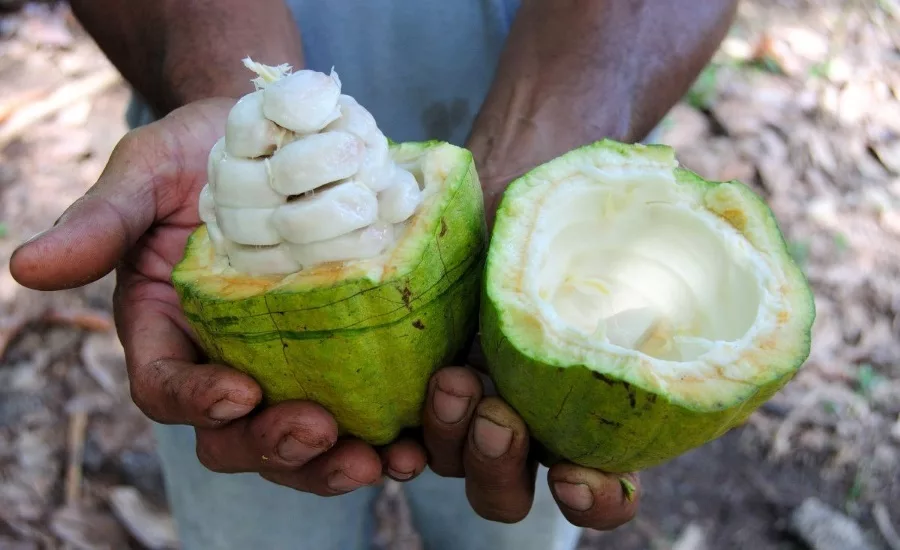
courtesy of: Barry Callebaut
Barry Callebaut has released a report showing key findings of cocoa farming in Côte d'Ivoire. The data analysis shows that poverty reduction is driven by three key factors: yield, size of farm, and price.
The results of the Agri-Logic research provide the foundation for the sharpening of Barry Callebaut's strategy to support cocoa farmers in achieving higher cocoa yields, increased income, and protect the forests surrounding cocoa farms. The results form the basis of the company's shift in approach from less training to more doing, with less emphasis on farmer training, and increasing investment to support the farmer with more labor, soil management techniques, and planting material. These findings provide actionable steps that underpin Barry Callebaut’s commencement of a transformative approach to improve the existing cocoa farming model in West Africa.
A picture of farming in Côte d’Ivoire
In Côte d’Ivoire, cocoa is predominantly grown by independent smallholder farmers. According to Agri-Logic data, the average farmer age is 48 years, with an average household size of 10.6 people, or 7.5 people when excluding dependents who may or may not be relatives, but are nonetheless dependent on the farm. In Côte d’Ivoire, farms are around 5.12 hectares in size, with an average of 3.61 hectares primarily dedicated to cocoa.
Key findings: Poverty reduction is driven by three factors
Using Agri-Logic’s Farmer Field Book Methodology, data and insights were collected from farmers on a range of topics, including farm investment, household profile, and environmental impacts. The data analysis shows that poverty reduction is driven by three key factors: yield, size of farm and price.
1. Cocoa yield is affected by farm location and investment
Annual rainfall of between 1,500mm and 2,000mm, well distributed throughout the year, is required to grow cocoa in optimal conditions in Côte d’Ivoire1. With regards to yield, the data analysis shows two findings:
The first is farm location. Farmers reporting highest cocoa yield in farms are located in regions which received significantly more rainfall (1,699 - 2,500mm), relative to the cocoa region’s average. In contrast, farms that are located in the center north and northeast of Côte d’Ivoire received below average rainfall, reported lower yields in these areas.
The second finding is that the level of farm investment in the form of additional labor and input, such as soil management techniques, also impacts cocoa yield. The data shows the difference between the bottom and the top quintile of investment levels was significant, with the top 20 percent of farmers collecting nearly double the yield (around 620 kg/ha on average) relative to the bottom quintile, where average yields were a little over 350 kg/ha.
2. Investment is also a critical factor with regards to farm size
The analysis shows that larger farm size does not automatically equate to increases in cocoa yield, in comparison to smaller farms. This is particularly representative when farm management is undertaken only by the household, without the investment of additional labor. In contrast, a large farm with an adequate level of investment, can drive a higher level of income by more cocoa being grown, resulting in higher yields and subsequently higher reported income.
"Farm investment is key. Roughly, a farmer on average will invest somewhere between $80 and $120 per hectare and that's simply not enough. With regards to farm size, bigger farm size matters, but a large farm only managed by the household without additional investment will not lead to higher yields and income," says Nicolas Mounard, VP sustainability and farming, Barry Callebaut.
3. Price mechanisms can support an increase in farmer income
With regards to higher price, the findings show that price mechanisms can support an increase in farmer income, which should be coupled with the other factors such as yield and farm size and farm location. Barry Callebaut acknowledges that higher farmgate prices lead to poverty reduction and that the appropriate mechanisms to achieve this should be analyzed in a broader context of price construction, for example the importance of farm gate price as well as export price, to achieve the biggest impact on farmers’ incomes.
"Price mechanisms can support an increase in farmer income, however, price should also include other factors such as cocoa yield, farm size, and farm location," says Mounard.
Systemic change is only possible through the participation of all supply chain actors
A fully sustainable cocoa and chocolate sector can only be achieved when all supply chain actors are committed to supporting the development of an enabling environment. By sharing this research, Barry Callebaut hopes that its change in approach from less training and more investment, into doing, will be a valuable contribution to the wider cocoa sector discussion on adaptations to the existing cocoa farming model in Côte d'Ivoire, and more broadly, West Africa.
Whilst the company's key findings indicate what activities and approaches should be undertaken to support farmers out of poverty, this must go hand in hand with the development of supporting policies to drive poverty reduction. This includes the development of integrated agricultural policies and land titles, that align national production targets with global demand. In addition, given the reported rate of deforestation in Côte d'Ivoire, it is critical that there is broader discussion on reforestation strategies and production of the same amount of cocoa on less land.
Looking for a reprint of this article?
From high-res PDFs to custom plaques, order your copy today!