Sustainability
Barry Callebaut wants to talk about cocoa farmer poverty
The chocolate company has committed that by 2025, more than 500,000 cocoa farmers in its supply chain will have been lifted out of poverty. Can they pull it off?
Editor’s note: Barry Callebaut recently hosted a press trip in Ghana, offering members of the media, including Candy Industry, an up-close look at its efforts there under the Forever Chocolate program. This article is part two in the three-part series.
The other parts in the series include:
Part 1: Barry Callebaut wants to talk about chocolate's child labor.
Part 3: Barry Callebaut wants to talk about climate change.
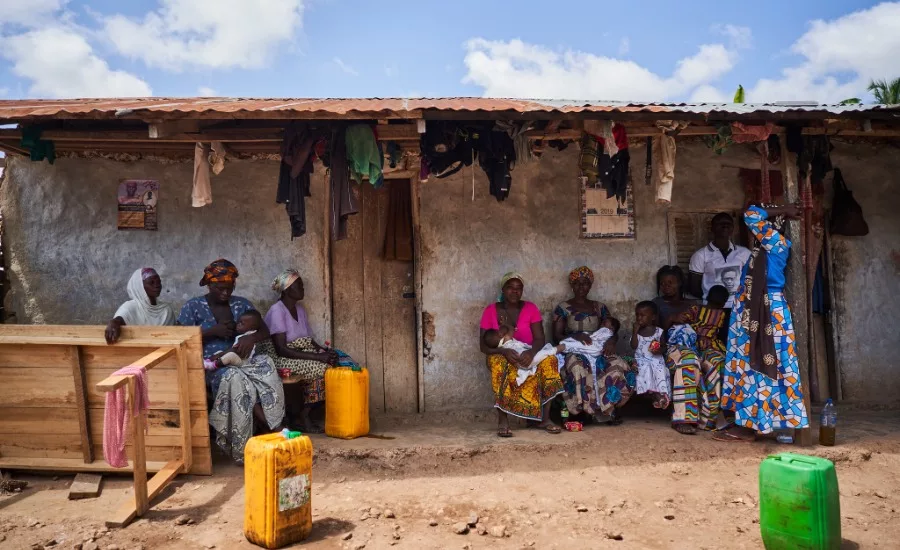
While in Ghana we stayed at hotels in the cities of Accra and Kumasi, which were thriving metropolitan centers. During the hot November days, Barry Callebaut took us to visit rural cocoa farming communities.
The houses in one of the small, rural villages we went to were made with sticks and dried mud. And the bathroom facilities were often just a hole in the ground behind a fence. Some of the villagers directly asked me to bring them fabric so they could make clothes out of it.
It’s no secret that many cocoa farmers make poverty-level wages. Indeed, the average cocoa farmer’s income per head per day is significantly below the World Banks’ extreme poverty line of $1.90 per head per day, or $676.40/year.
What does that look like in practice in Ghana? Nicko Debenham, VP head of sustainability for Barry Callebaut, says the average farm size is about 2 to 4 hectares, and one hectare typically yields about 450 kg. One ton of cocoa will generate at least $1,820 for the farmer. Add in dependents and the math gets difficult.
“If you think about cocoa productivity and the capacity of that farmer on that farm to work themselves out of poverty if they have five children, husband or wife and potentially one other dependent... that’s a big ask,” Debenham says. “That’s the kind of challenge that we face.”
And it’s not as though cocoa farming is easy. The cocoa farmers have to tend their farms throughout the year and hack down cocoa pods from the trees at harvest times. After they collect the pods, they cut each one open with a machete and take out all the cocoa beans by hand. Then they let the beans dry out before bagging them up and selling them.
Not surprisingly, the back-breaking work for low wages isn’t attracting the next generation.
In fact, John Afful, a 42-year-old cocoa farmer in Ghana, hopes his family won’t follow in his footsteps. While his father was a cocoa farmer and he is as well, he hopes that his five children will find different work.
In other words, if Barry Callebaut doesn’t make cocoa farming more appealing, there aren’t going to be any cocoa farmers left.
The chocolate company is approaching farmer poverty in a number of different ways, though.
For example the company is offering coaching so that they can increase their yields, while also helping them gain access to credit and creating farmer business plans.
Barry Callebaut already has run some pilot programs, and they plan to scale them up over the coming year, with the hope of seeing real results in the next two to three years.
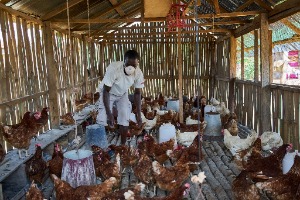 In one program they give farmers chickens to raise because they are easy to take care of and can exponentially increase a family’s income when they sell the eggs. They also helped them to start soap making and honey farming.
“We're looking to create a portfolio that enables farmers to have multiple options based on their locations but also their capacity,” Debenham says. “So if you’re a 55-year-old farmer we don’t want to give you a diversity of income choice that requires a lot of hard work. You need to give them a diversity of income choices that’s light work so that they can manage or cope with the additional opportunity.”
Not all of Barry Callebaut’s pilot programs have been successful. They also tried to help cocoa farmers grow vegetables. But it turns out that vegetables take a lot of work and the market for them was too fickle.
“It’s a very difficult thing for somebody to do something and fail and then see that the learning is the success,” Debenham says. “So what we say about the pilots is that failure is success as long as you learn.”
While rural poverty can seem inescapable, the truth is that within one generation an entire family trajectory can shift.
And that lesson has been reinforced by the data Barry Callebaut has collected.
“It’s amazing how when you do a baseline how much stuff you learn that’s so obvious. You think afterwards, of course,” Debenham says. “Children of parents who are educated don’t work on the farm. It’s so obvious. But even the ones who are really on the edge of poverty, if the parents went to school and can read and write their children are not working on the farm. So the solution to child labor is to educate this next generation 100 percent.”
So what happens if Barry Callebaut’s efforts work too well? What happens if nobody wants to be a cocoa farmer anymore? Well, the company is actually hoping to shift the entire working model for cocoa farming to account for that.
“The long-term resolution of the challenge, is in some ways, is not dissimilar to what happened in Western Europe 60 years ago,” says Barry Callebaut’s CEO Antoine de Saint-Affrique. “You need to evolve the way you cultivate, you need to increase your yields, you need to diversify your revenues, you need to professionalize the entire thing. And you need, at some point, also to slightly expand the size of your exploitation as some of the farmers are retiring.”
As of right now, Barry Callebaut has successfully helped lift 184,000 farmers out of poverty, or about a third of the 500,000 in its supply chain they want to help by 2025.
“But funnily enough that last two thirds is going to be — that’s like the top end of Everest,” Debenham says.
How will the LID impact cocoa farmers?
It’s impossible to talk about farmer poverty without mentioning LID, or the Living Income Differential.
LID is a new pricing structure for cocoa created with an agreement between Ghana and Ivory Coast and it requires all companies buying cocoa from either of the two countries to pay $400 more per ton above the market selling price. The LID goes into effect for the 2020/21 season.
The plan is that this additional $400 will be used to make sure the minimum price for cocoa from the two countries never drops below $2,600 per ton. At the price, the farmers in Ghana and the Ivory Coast are guaranteed $1,820 per ton. If the price of cocoa goes above $2,600 then the additional money goes into a fund run by the two countries. Then, that fund can be used to subsidize payments to farmers if the price of cocoa drops too low.
In the end, it means the farmers are personally guaranteed $300 more per ton, with the additional $100 going to the governing bodies that facilitate the sale of cocoa in the two countries.
LID is not impacted by laws that prohibit collusion because it’s not the cocoa companies getting together and agreeing to pay more — rather it’s the countries that are asking for the additional money.
Barry Callebaut supports the LID, despite the fact it will increase their prices. The LID will actually help with Barry Callebaut’s goal to lift 500,000 farmers out of poverty.
“This is one of the best things that’s happened for us,” Debenham says. “Because there’s me sweating blood thinking, how the hell am I going to achieve that? And these guys have just given me a $400/ton boost.”
But he cautions that the LID alone won’t solve farmer poverty.
“What we’re trying to push for as an industry is a balance that says it’s not just this $400. That’s not going to solve the problem,” Debenham explains. “It needs to be about diversity of income, greater effectiveness and efficiency on the farm. Higher productivity. Other income generating activities, women’s empowerment and so on. “
It’s too early to know exactly how the LID will impact things. And some have voiced concern over what will happen to any additional money the countries get if the cocoa price is high enough. However, Debenham says that since two countries will oversee the fund there’s less of a chance that the governments will be able to tap into the fund to pay for other things.
“It’s not going to be used for anything apart from supporting the price,” he explains. “It is just going to a stabilization fund to support the farmers.”
Also, the LID only applies to Ghana and Ivory Coast, which puts other cocoa-producing countries such as Ecuador and Brazil at an advantage because ingredient companies won’t have to pay the additional $400 per ton there. But Debenham says those countries don’t produce enough cocoa to take all the business away from Ghana and Ivory Coast.
It’s also tempting to assume that the LID will eventually increase the price of chocolate. But, de Saint Affrique doesn’t see that happening. Cocoa beans only account for about 10 percent of the final chocolate product, and he expects the additional costs will be absorbed throughout the supply chain.
One of the cornerstones to success or failure is getting farmers out of poverty. Because if you have farmers in poverty you’re not going to solve the problems of child labor, and you’re certainly not going to solve the problems of deforestation.
– Nicko Debenham, VP head of sustainability for Barry Callebaut.
“I don’t expect a significant impact on consumers because obviously it depends on the industry,” he says. “But if you take the price of the cocoa beans in the chocolate chips, you have an effective dilution. I cannot calculate it, but you have an effective dilution that is quite important.”
And de Saint-Affrique has been publicly supporting the LID as well. But it raises the next question: If $400 more a ton helps farmers, couldn’t the countries just ask for $600 more a ton or even $1,000 more a ton? Wouldn’t that help them even more?
But de Saint-Affrique says price won’t solve everything. And the market prices for the other countries also won’t go up, which means the price in Ghana and Ivory Coast has to remain competitive.
“There is a point of balance which you need to find, because there are counter effects,” he explains.
It remains to be seen how the LID and all of Barry Callebaut’s efforts will truly impact farmers, but they seem to know how important the goal is.
“One of the cornerstones to success or failure is getting farmers out of poverty,” Debenham says. “Because if you have farmers in poverty you’re not going to solve the problems of child labor, and you’re certainly not going to solve the problems of deforestation.”
Read the other parts of this series to see how Barry Callebaut is working to eradicate child labor and combat climate change.
Part 1: Barry Callebaut wants to talk about chocolate's child labor
Part 3: Barry Callebaut wants to talk about climate change
Looking for a reprint of this article?
From high-res PDFs to custom plaques, order your copy today!