Chewy candy defines the texture playbook
The confections can be layered, whimsical, and plant-powered.
I’ve always had a soft spot for chewy candy—gummies, ropes, licorice, you name it, I’ve indulged. Choosing a favorite is nearly impossible. I’m drawn to today’s dual-textured products with their crunchy-on-the-outside, soft-on-the-inside experience. But I’ll happily go back to the basics. A starch-based soft gummy with a mix of sour and fruit flavors never disappoints. Lately, I’ve even found myself revisiting licorice— Swedish-style. The dense chew that breaks down easily in your mouth is, for me, a sensory delight.
Sales data would suggest I’m not alone. Last year, Americans spent $5.5 billion on gummy, chewy, and licorice confections.1 Let’s face it. Few people can resist the bright colors, fun shapes and tantalizing textures of chewy candies—particularly among today’s value-seeking consumers. Yet from soft chews to an “elastic” experience, the science behind these gummy-style treats is basically the same: sugar systems structured with one or more gelling agents.
Within that framework, however, the range of textural possibilities is vast. On one end are quick-dissolving gummies, with soft bites or soft shells with juicy centers. At the other end are firm, dense chews—think licorice or super-firm gummy worms that take their time breaking down. And in between, developers are increasingly exploring multi-textured candies that layer sensations for added excitement.
Texture is the joy multiplier
In confectionery, joy is the primary objective, and texture innovation brings that joy to life. Where developers were once constrained by gelatin, today’s plant-based ingredients open the door to greater textural exploration. While they won’t behave exactly the same as the animal-based protein, they don’t need to. They can deliver eating experiences that are remarkably similar or push beyond into entirely new sensory delights.
But the conversation isn’t only about texture. Plant-based systems offer brands broader appeal, from vegan positioning and religious certifications to evolving consumer expectations around ingredient sourcing. For many manufacturers, plant-based formulation is a platform for creativity, differentiation and growth.
The building blocks behind modern chews
Realizing that potential starts with understanding how different plant-based texturants perform under real-world formulation and processing conditions. Pectin is a frequent alternative to gelatin, offering excellent shelf-life stability. Its gel is non-reversible and fast-setting, meaning it holds intricate shapes and fine details through processing, shipping, and storage. It also offers excellent flavor release, making pectin ideal for fruit-forward applications. The trade-off, however, is a relatively narrow texture range. Pectin systems typically produce a firm, somewhat brittle bite that breaks down cleanly in the mouth.
Sourced from red seaweed, carrageenan offers far more textural versatility. Some options create elastic, gelatin-like textures that stretch without snapping. Others produce firmer, more brittle gels closer to pectin. Blending different carrageenan types unlocks even more possibilities, spanning gooey interiors, aerated confections and layered systems. Or pair any of these textures with a hard shell to deliver a compelling, multi-textural experience. For formulators seeking textural novelty, carrageenan is an incredibly powerful tool.
Starches and flours—often corn- or wheat-based—bring supply stability and strong consumer familiarity. Texturally, they provide softness and a gentle breakdown in the mouth. They won’t deliver a sharp initial bite, but they excel in applications where a tender chew is desired and can be easier to formulate with compared to hydrocolloids and gums.
The real creativity emerges when these ingredients are combined. Need faster set? Add pectin. Want to elongate the bite? Select the right carrageenan. Building a dual-texture gummy? Expect to use a minimum of two texturants, and likely more. The interior and exterior layers will demand different solutions. No single ingredient can achieve all those effects alone.
Translating sensory ideas into structure
With so many plant-based tools to choose from, the bigger challenge often lies in defining the job to be done. When developers approach us with a new product idea, it usually centers around a broad sensory vision. Our role is to translate that vision into textural triggers. Do they want a soft, gooey center or something more elastic? A firm bite or a dry, foamy chew? A crunchy exterior that fractures before revealing a tender core? Fortunately, all that and more can be created using plant-based ingredients.
Manufacturers who have exclusively worked with gelatin will notice a few differences. Gelatin sets at relatively low temperatures, which can limit high-speed processing. Plant-based pectin, on the other hand, gels at much higher temperatures. Depending on the product, that can allow manufacturers to move more quickly through depositing equipment. Pectin systems also require precise pH control to achieve optimal set and texture, whereas gelatin sets in a wide range of conditions.
Some textures will take a bit more work to achieve with plant-based ingredients. A foam-type gummy requires aeration. Carrageenan can help create structure and hold air, but it won’t whip air into the system. For that, formulators typically incorporate a plant protein—pea, soy, or potato—to create the aeration, while carrageenan stabilizes the final result.
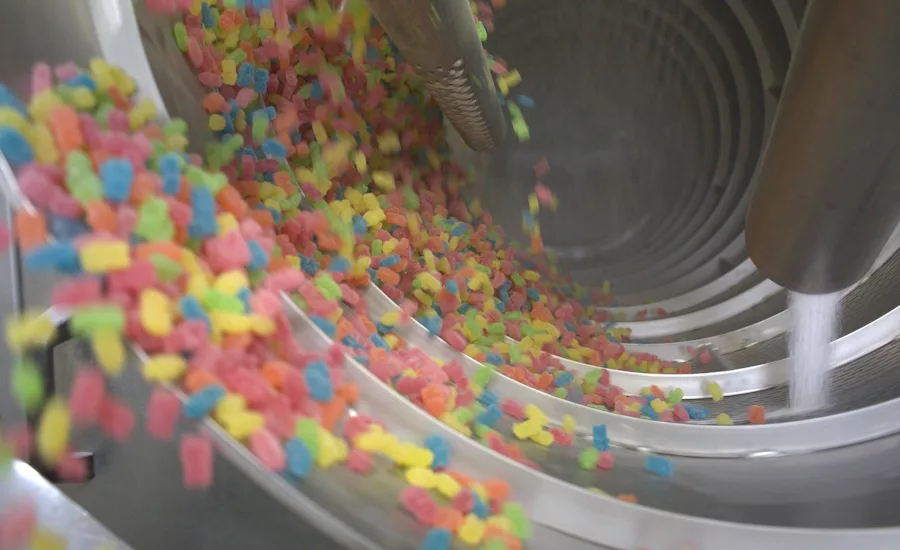
Other trickier challenges include super-elastic gummies and clustered-style gummies where the goal is a sticky, soft yet elastic interior eating experience, followed by an exterior coating—such as sanded sugar or colored sugar beads—that delivers crunch. These formats require additional experimentation to dial in both texture performance and manufacturing efficiency. Dual texture systems will also require careful moisture migration management between layers to maintain bite integrity over shelf life.
Cargill supports these complex formulation projects through a broad network of technical, consumer, and sensory experts who work side by side with customers. That combination of scientific depth and practical application experience helps translate abstract sensory goals—from elastic stretch and gooey centers to crunchy-soft contrasts—into scalable, manufacturable systems. By pairing ingredient science with real-world processing and sensory expertise, concepts can move efficiently from benchtop trials to commercialization.
Winning the texture arms race
That speed and agility matter in a category where competitive pressure continues to intensify. Chewy candy occupies a unique space in the aisle, delivering strong value—often at a lower price point than chocolate—while still offering room for premiumization through texture and flavor innovation. At the same time, innovation often moves quickly.
Trends like freeze-dried candy illustrate just how fast excitement can build as social media accelerates discovery. Manufacturers who can rapidly convert concepts into market-ready products are best positioned to capture that momentum. For larger brands, that may mean not getting boxed in by their own operational limitations or narrowly defined texture systems.
Manufacturers that have historically relied on gelatin should recognize that plant-based chewy candies aren’t as big of a hurdle as they imagine. There’s a rich portfolio of plant-based ingredients capable of delivering both creativity and enjoyment to the gummy candy space, backed by ingredient suppliers with deep formulation experience to guide the way.
Where texture, science, and joy meet
The future of chewy candy isn’t about choosing between gelatin and plant-based. It’s about understanding how each performs and leveraging the full spectrum of textural science to deliver layered, playful, and surprising eating experiences.
At the end of the day, consumers don’t think in hydrocolloids. They think in moments of joy. The brands that master texture innovation are the ones that will win those moments.
1NielsenIQ, 2025
Looking for a reprint of this article?
From high-res PDFs to custom plaques, order your copy today!