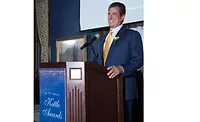
How Ted Cohen shaped the sugar-free candy sector we know today
Recent Kettle Award recipient Ted Cohen helped launch the sugar-free hard candy category with Hillside Candy.
You could say that modern day sugar-free hard candy can trace its roots back to an off-the-hook telephone. Or at least, back to the reason the phone was off the hook.
You see, a guy named Myron Fisher was running a one-man candy maker operation, and he was exhausted.
“He was literally making the candy, wrapping the candy, servicing the equipment, doing everything seven days a week and he was getting tired of it,” explains Ted Cohen, who recently received the 74th Annual Candy Industry Kettle Award for all of his work in the industry — including his vital role in creating sugar-free hard candy.
Cohen says the retailer who was working with Fisher didn’t want to give up his supplier. So, one thing led to another, and Bill Cohen (Ted’s father) ended up coming by to check out the company to see if he could somehow keep it running.
When he got there, he realized there was no doorbell, so he just walked inside.
“And there's this tiny desk with a rotary phone that's off the hook. Literally, just a single item,” Ted Cohen says. “So he walks in the back and there's this little guy in a uniform and he's making candy. “My father says, ‘Excuse me.’ [Fisher says,] ‘Yeah, what do you want? I got no time for you. What do you want? Sales? What do you sell?’ That was the way the conversation started.”
Bill told him he wasn’t there to sell him anything and pointed out that Fisher’s phone was off the hook.
“Fisher says, ‘Yeah, the thing rings all the time. It's a pain in the ass. Everyone wants more candy and I can't make any more candy. I'm sick of this,’” Cohen says.
That’s when Bill Cohen got a spark of inspiration — he could buy the company.
And he knew just the person to run it — his son, Ted. Ted had just recently graduated from Boston University with a BS/BA in business management, and was working in Washington D.C.
“I was straight out of college and my dad calls me and says, ‘Look, we can buy this thing for a song.’” Ted Cohen says. “I think it was $200,000 for the company and [my dad] said, ‘Would you have any interest in leaving your job and coming here and getting into the candy business?’”
At the time, Ted Cohen had still expected to go into the family’s multi-generation uniform business, which was started by his grandfather in 1928. Raised in New Jersey, Cohen spent his summers and vacations driving truck routes and learning the uniform business.
But fate had sweeter plans for him.
He took the job, and officially got into business with Fisher, who decided to stay on and work with him. It’s a decision that would turn out to be a vital chapter in the story of sugar-free hard candy.
“I came in and I walked through the door. I was the second full-time person, and I met Mike, which was kind of an experience,” Cohen recalls. “Mike was my dad's age and had no interest in raising another kid or teaching me the business at the time, and here he thought I was a snot-nosed kid who was going to come in, work here for a little while, and then go into daddy's business.”
That’s not what happened. Instead, Cohen helped grow the company.
“When I got in it was straight sugar candy,” Cohen explains. “We didn't have the wrappers, we had no packaging, we had zero retail product, nothing, no bagging.”
Eventually, Cohen was able to get production up.
“We got this crazy little machine that put candy into a stand-up bag and we put ribbons on it, labels on it, and tried to develop a retail business,” he says. “And you can imagine, there were three of us. And that's the way it started.”
Then came the next chapter in the sugar-free hard candy story.
Cohen realized he needed to find another way for the company stand out, and he quickly realized he only had so many options.
“I saw that we had the limited capacity with a single piece of equipment. You can only do a hard-boiled production piece and where was that going to go?” Cohen recalls. “It was sugar candy. I was fighting against Life Savers and Jolly Ranchers and brands like that.
"I couldn't compete with that. I had to figure out how to make a different type of specialty gourmet upscale product with a niche difference.
“I said, what else can I do with this piece of equipment? And sugar-free started to make sense,” Cohen says.
Once he decided to get into sugar-free, though, he had another problem to overcome — figuring out how to make it.
See, sugar isn’t just a fun sweetener for hard candies, it’s also a main structural component.
“We were playing around, but it was very difficult,” Cohen explains. “The trick to sugar-free candy is you have to get all the moisture out otherwise it gets really sticky and tacky.”
So he and Fisher, started playing around with it over an open fire. They soon realized that wasn’t going to work. Then they had a break-through.
“We finally got something that made sense,” Cohen says. “What we had to do was vacuum cook it.”
That was the trick to getting all the moisture out. Then they realized there was a vacuum cooking machine that had come with the factory when they purchased the company. It had never even been plugged in. It worked! They eventually took the resulting product to market.
They also had to figure out the best sweetener. They started with hydrogenated starch hydrosolate, which sounded like a chemical. Eventually they learned to combine Splenda with the HSH, and it made a great piece of candy.
But they had to work through a lot of trial and error.
“We were taking back as much as we were shipping out,” Cohen says. “Because we couldn't get the stability right and then once we get the stability right, we were able to get better flavors and better texture in the flavoring and then it grew from there.”
Overall, Cohen got in on the ground floor of the sugar-free sector.
“At the time that I started sugar-free, the only company that was out there was Estee, which was part of a bigger company and they were doing sugar-free jams and peanut butter,” Cohen recalls. “It was solely for diabetic trade and I was kind of the second person in.”
And they had a different marketing strategy.
“We were trying not to market to diabetics at all,” he explains. “We were trying to say that we were an alternative to sugar-based confections. We actually could prove that we had one third the calories of sugar-based candy.”
But they did run into some regulation issues.
“To put the calories on the back end to make a reduction in calories on the front of the packaging. That all became FDA guidelines stuff,” Cohen says. “So they forced your hand and in the early '80s you could get by with just about anything because it wasn't being controlled and that was in the 1980s, if you go to 2019, 2020, forget it.”
Cohen also innovated in other ways, including flavors. Specifically, introduced chocolate flavors into sugar-free.
“I didn't have a focus group that we could go to. I went out and I went to stores and I looked around, what was a good flavor, what made sense?” Cohen explains. “I was the first one to introduce chocolate into hard candies. No one did that before. And chocolate mint for us was a fabulous item for us.”
He was a big believer in not going first to market and instead waiting to see what others did and then finding ways to improve it.
And 15 years after that, they moved into the next healthy treat category — organic.
“I saw in the market what was happening in produce and meats,” Cohen says. “The whole world was going more towards organic. And again, I thought, with a single piece of equipment, what can I do differently? There's only so many things that you can process through a cooker like that. So we started to make organic. And I think we were the innovators in organic candy.”
Finding an organic syrup was difficult, though.
“We had trouble finding a steady supplier for syrup that was clean, processed well, that was consistent,” Cohen says. “Some people wanted to get our business and they would send us in syrup and it could have tremendous variations. So the brown rice syrup had to be very consistent in order to cook it and we searched long and hard. The supplier that we had, in the beginning, couldn't keep up with our demand. Now, they have no problem doing that.”
Once they got the formula down, they had to get it on store shelves, which came with its own challenges.
“It was knocking on doors a lot back in the day,” Cohen says. “Then as Whole Foods started to pick up the product, it made it a little bit easier because then you had a success story.”
He said that was a major step for the company.
“The hardest part with every supermarket chain is they say, ‘Okay, show me where your data is from the other supermarket chains.’ Well, it's the chicken or the egg. Which comes first? How can I give you data of my success if I don't have anyone who's bought it yet? And I got hit with that a lot.”
And that’s where the real success started to happen.
“Even today, I would tell you that the greatest success for a company like ours is not going to be a Safeway or Kroger,” Cohen says.
These days, Cohen is no longer involved in the day-to-day of the company. In 2016, he sold it to Highlander Partners, which now runs a confectionery group called Bettera Brands. He is still involved, but in more of an advisory position within the company. He continues to be involved in the confectionery industry overall, serving on the NCA’s Board.
“At first, I can say when I sold the company I stayed on for a long time here, I lived here [in NJ]. I had no employment contract, they wanted me to stay for as long as I wanted. But I knew after six months that I didn't have the same passion, the same drive as when it was mine,” Cohen says. “I essentially had gone from owner to employee. I can't say that that's a bad thing, it's just different. When I started to feel like I didn't have the same drive and oomph to continue to better the sales of the company — which is what every company needs — I said, ‘You know what? It's time for them to move on.”
Cohen’s reflections on receiving the Kettle
It’s been a long road for Cohen, but it’s clearly been worth it. Although he doesn’t always see his own value. When he first heard he had been nominated for 74th Annual Candy Industry Kettle Award, he actually turned it down.
“I said, ‘I'm honored, but no thanks,’” Cohen recalls. “A guy like me has a low chance and you should really nominate a big guy.”
But he decided to take some more time to consider it.
“I said, ‘You know what? Give me a day.’ I spoke to my wife and I called a couple of friends from the industry and I said, ‘What do you think?’ and they said, ‘Of course, you accept it! So what if you don't win? The big honor in the Kettle Awards is just to be nominated!’ I couldn't say no, so I said, ‘Okay.’”
Obviously, Cohen was wrong about having no chance at being the Kettle recipient. This past May, at a formal reception held at Chicago’s Union League Club, he was named the 2019 recipient of the award, which was established in 1946 by Candy Industry's founder and publisher, Don Gussow. It represents the highest recognition an individual working within the U.S. confectionery industry can attain.
Cohen was shocked when he heard his name — so shocked that he didn’t even have a speech prepared.
“What am I going to prepare an acceptance speech for? I didn't have any chance,” he explains. “And when they first announced it, I was looking around like, who? It was very humbling.”
Turns out everyone else in the industry saw his worth quite clearly.
Looking for a reprint of this article?
From high-res PDFs to custom plaques, order your copy today!