HRS develops chocolate tempering solution
The company will bring its equipment to PACK EXPO this year.
Courtesy of HRS
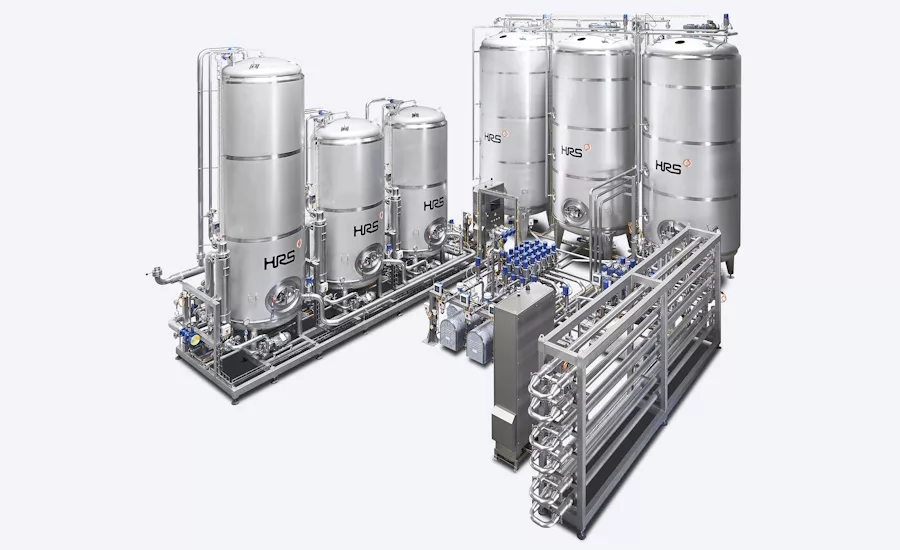
HRS Heat Exchangers will show PACK EXPO Las Vegas visitors the benefits of tempering chocolate using the HRS R Series of rotary scraped surface heat exchangers. It will also demonstrate a number of other highlights from its range of heat transfer equipment and systems for the food and beverage industry.
Tempering chocolate is necessary to produce consistently small crystals of cocoa butter when it is heated and cooled. Without this strict temperature control, the crystals formed are of different sizes and the resulting chocolate will "bloom," having a matte appearance and waxy texture.
Recently, following a request from a key client who processes bulk chocolate from a number of suppliers, HRS worked with the client to develop a chocolate tempering solution which could be mounted on a process skid.
We connected with Matt Hale, HRS global key account director, to learn more.
Liz Parker Kuhn: Can you talk a bit about HRS’s heat exchangers, and how they can be used with tempering chocolate?
Matt Hale: HRS produce a wide range of corrugated tube and scraped surface heat exchangers (SSHEs) which are suitable for numerous applications in the food and beverage industry. In particular, our R Series of rotating SSHEs and our UNICUS Series of reciprocating SSHEs have been shown to provide different combinations of mixing and agitation, meaning that using different scraper designs and speeds, we can find a solution for the most challenging materials, such as different types of chocolate.
LPK: How did HRS work with its client to develop a chocolate tempering solution which could be mounted on a process skid?
MH: Using samples of the product we first ascertained the feasibility of handling the chocolate without damaging the quality and determined that the HRS R Series was suitable for the required process. We then developed the equipment to deliver the right combination of heating and cooling with a footprint that would allow it to be skid-mounted.
The supplied solution comprises three R Series rotary scraped surface heat exchangers in series; the first raises the temperature by 119°F, and the second then cools it back down by 3.6°F, before the final heat exchanger raises the temperature to a level allowing the chocolate to be transported and worked elsewhere in the factory.
LPK: Was the system able to speed up processing time?
MH: The new heat exchangers have significantly speeded up the tempering process, increasing the volume of product that the factory can handle.
LPK: What other things were factored into the client’s decision to go with HRS’s heat exchangers?
MH: Because the client’s factory operates 24 hours a day for eleven months of the year, it was important that the heat exchangers are robust and reliable. Energy efficiency and the ease of installation from a skid-mounted solution were also considerations.
LPK: How can the HRS R Series allow small solids, like pieces of nuts or honeycomb, to be included in the molten chocolate?
MH: The HRS R Series features a helical scraper bar design which prevents the build-up of viscous products, such as molten chocolate, on the tube surface to maintain efficient heat transfer. However, we can change the geometry of the scrapers and as there is a gap between them and the side walls of the heat exchanger, small solids, such as pieces of nuts or honeycomb, can be included in the molten chocolate without damaging them or the integrity of the product.
LPK: Any other confectionery partnerships / opportunities coming up for HRS?
MH: Having proven the suitability of the HRS R Series for tempering chocolate, we are happy to discuss any potential projects with other companies in the confectionary sector.
Related: HRS Heat Exchangers earns 3-A approval for key food models
Looking for a reprint of this article?
From high-res PDFs to custom plaques, order your copy today!



.webp?height=200&t=1714488495&width=200 "Podcast: Nexty Award winning chocolate with Macalat Chocolate")