Right in Control
By Dan Malovany
Five years ago when Brian Sisson joined ACE Bakery, almost
everything in production was done by hand. That included ingredient handling,
the make up process, the use of walk-in proofers and ambient cooling on racks,
the loading into stone-deck ovens and even sending product through a walk-in
blast freezer.
For Sisson, one of the last graduates of the American
Institute of Baking before it left Chicago in the 1970s, the new position was
quite a contrast to working as director of operations at Weston Bakeries.
Still, what he liked about ACE Bakery is that the company
did things right. The bakery followed the correct times and temperatures when
it came to mixing, proofing and baking. Small dough batches received long
fermentation times to develop flavor. Moreover, the all-natural products were
made using a variety of European-style starters and sours.
“When I came here, all of the production activity was taking
place in one room, and we were making baguettes with one old French molder,”
recalls Sisson, the current director of operations for the Toronto-based
company. “I joined the company in the midst of it being a pretty manual
operation and going into automation, but keeping within the principles of
artisan baking.”
Today, the 33,000-sq.-ft. facility that has 50,000 sq. ft.
of production space – thanks to the efficient use of vertical space – houses
three versatile lines that produce thousands of artisan breads and rolls an
hour, seven days a week. True to its roots, the bakery still fills small orders
of handmade custom-formulated products. The main distinction between the manual
aspects of the past and the automated processes it uses today is largely a
function of how the dough moves around the bakery. The critical aspects of the
production that are integral to the quality of the bread are still the same,
notes Philip Shaw, president and CEO of the company.
“Even when the bread is made on the line, there are still a
number of ‘touch points’ influencing the final characteristic of the product,
whether it’s shaping or scoring,” he says.
Automating the production of artisan baked goods, he adds,
requires a delicate balance between technology and the human element, between
flexibility and controls and between the art and science of baking.
“It’s a living product,” Shaw notes. “If you’re manufacturing
clothing and cutting and sewing fabric, the product is exactly the same Monday
through Friday. It’s undistinguishable. We have the added complication with our
products that one of the variables to quality involves influences outside of
our control like weather. Higher humidity content affects the quality of the
product. There are those things we can’t influence so we make an extra effort
to have our bakers focus on those things we can influence.”
To create the necessary controls, Michelle Heywood, customer
service and quality control manager, works with employees, supervisors, Sisson
and Marcus Mariathas, director of product development, to create the
statistical and human controls for the process. They also communicate where the
“touch points” are to ensure that products meet the company’s specifications.
However, unlike with sliced white bread and other
commercially produced baked goods, Heywood notes, creating artisan breads and
rolls is anything but an exact science.
“We set a target standard and then a variance within it,”
she says. “You’re talking about a couple inches on length or width and an inch
on the height. With scoring, you want all three cuts to open, and the staff is
trained to look for that.”
For its Potato Chive Focaccia, for instance, sliced potatoes
are hydrated in water so they don’t discolor before they are hand placed atop
the bread. Standard operating procedures (SOPs) with images of acceptable and
unacceptable products are located throughout the facility.
Another product, the bakery’s Olive Fougasse, was perhaps
one of the most challenging for Mariathas and Sisson to automate due to its
high-level of hydration and the required scoring.
Additionally, the product needs a long fermentation time
combined with hydration levels that make it sticky and gassy. Because bakers
cut the dough by length, and not by weight, obtaining consistent, accurate
weights can be a challenge.
“You don’t want to be underweight, and if you’re heavy, it
doesn’t bake as well,” Sisson explains.
To control costs, Jonathan Roiter, chief operating officer,
began adding the rigorous analysis and diagnostic processes that he employed as
an operational consultant with McKinsey & Co. prior to joining ACE Bakery
in 2007.
For instance, instead of measuring waste on a weekly basis,
the bakery started monitoring it using an hour-by-hour, product-by-product
approach. That allowed the operation to remedy any problems the next day. If
there’s an issue, Roiter meets with bakers to discuss what happened the
previous day, to drill down to the root causes of the waste and to develop
suggestions to improve the process.
“It’s more than just management by statistics,” he says.
While many companies have key performance indicators (KPIs)
to gauge their success, Roiter implemented a tool called overall equipment
effectiveness (OEE) that’s designed to increase plant efficiency, troubleshoot
any problems and determine maximum performance of production. The data-driven
process is highly quantitative, but Roiter uses metrics that take into affect
the human and technical elements of production. Every Thursday, in fact, he
meets with the production team to facilitate discussion and ameliorate any
issues such as downtime, waste and other critical factors.
Take, for example, a problem that the bakery had with oven
downtime. By using OEE and other analytical methods, Roiter and the bakers
discovered that if olive oil, used as a top dressing on bread, transfers onto
one of the oven loading belts, it can cause belt slippage and can crash the system.
“That didn’t come from me,” he says. “The employees on the
front line share their expertise. I noticed that when they were running this
type of product, the machine broke down more often.”
Always in Production
Because the bakery produces organic breads, the operation
needs to develop a detailed paper trail, tracking everything from incoming
ingredients to the time the products leave the door. As a matter of practice,
all ingredients are monitored by batch before they enter the mixer with a
strong fundamental emphasis on time and temperature throughout the process.
“Our manufacturing environment is process-controlled, and
each level is monitored for both the mix and fermentation time as well as dough
temperature,” Sisson says.
The facility also is dairy-free because it produces Kosher
products and nut-free to eliminate allergens. Products such as its Artisan
Crisps and Granola that contain nuts are produced in a separate 6,000-sq.-ft.
operation just a stone’s throw away from the main bakery.
Because of its different fermentation times, ACE Bakery uses
staggered shifts where the company’s more than 200 production employees are
continuously coming and leaving the bakery on an almost hourly basis, says
Fiona Mitchell, vice president of human resources.
“No three, eight-hour shifts here,” she says. “You don’t
have a total changeover. People are coming and going. It’s a struggle for
supervisors because they have to manage everyone’s breaks and when they leave.
It’s variable, but they’re used to multi-tasking. It’s certainly not straight
forward.”
The plant’s two, 50,000-lb. silos supply the bakery with
flour. To maximize space, a boiler, water chillers and a glycol system are
located on a mezzanine floor with central temperature and humidity controls for
the natural fermentation of the dough. In fact, temperature in the bakery is
maintained at 72°F to 76°F with 60% relative humidity to enhance product
consistency. Exact water temperature is produced by combining city water with
water from a dedicated water chiller. Flour sifters and scales are located
above the mixing department.
To create its authentic products, ACE Bakery relies on 12
different starters ranging from poolish and liquid starter to sourdough and
biga. Some of these sponges ferment up to 24 hours.
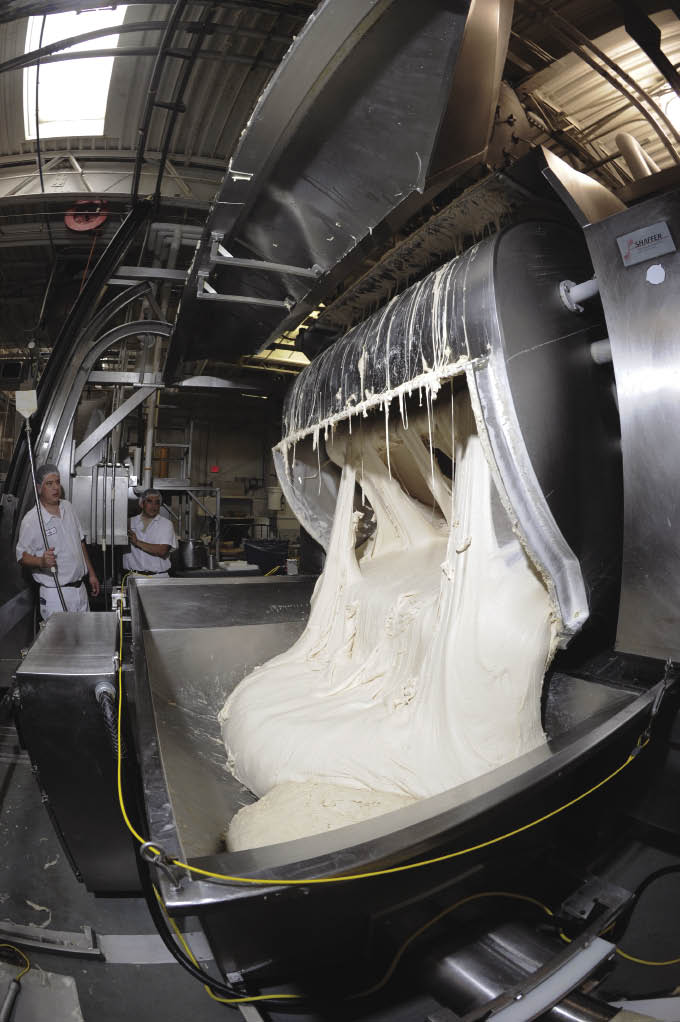
Six 550-lb. spiral mixers feed two bread lines that can
crank out 3,000, 24-in. baguettes or more than 5,000 lb. of product per hour.
The bakery also has a third line that can make 12,000 rolls an hour.
Typically, the bakery achieves low-stress makeup and dough
handling much in the way a laminating line works. After the mixer bowls are
elevated to the hopper, the dough is gently sheeted out using a reduction
station, cross roller, two roller stations and a flour duster and remover
before the sheets are cut into four or five rows, depending on the product.
They’re then guillotined by length before eventually dropping onto plastic peel
boards. To set up a line, an operator selects the product on the programmable
controls.
The plant has two automatic proofers that provide a full
range of control for temperature, humidity and proof times that can range
anywhere from 40 minutes to three hours with these systems. The facility also
has a small walk-in proof box and rack ovens for small-order, specialty items.
Then, peel boards travel down from the proofers to one of
two “lowerators” before the products are unloaded on a “scrabbler” and
automatically placed in one of five multi-deck, thermal oil ovens. Three of
these systems have nine separate decks and a dedicated loader/unloader. Two
systems have 14 decks each, but they share one oven loader.
After traveling on two racetrack or ceiling conveyors, the
high-volume products enter either a single or dual spiral blast freezer before
metal detection and packaging. Low-volume specialty items, on the other hand,
are frozen in a rack freezer that holds about 3,300 lb. of product. Some
organic breads are sliced and bagged before freezing. Fresh items are bagged
and placed in baskets or in corrugated boxes before shipping.
Most of the frozen parbaked products are casepacked and
palletized before heading to the bakery’s holding freezer or to a nearby
offsite cold storage facility.
Sisson and Mariathas recently have spent time in Europe
evaluating manufacturing equipment, and in the New Year, ACE Bakery will begin
installing a new bread line to increase production capacity to address its
growth needs.
For ACE Bakery, the keys to automating the production of
artisan breads and rolls involve control and balance, which are not necessarily
easy things to achieve.
“Our goal is to have
the product consistency and process controls associated with a large commercial
bakery while maintaining the product quality of a small boutique artisan
bakery,” Sisson says.
That’s how the bakery stays right in control.
Looking for a reprint of this article?
From high-res PDFs to custom plaques, order your copy today!