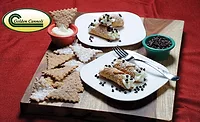
Creating cannoli
From humble beginnings 40+ years ago in a small bakery near Boston to a 30,000-sq.-ft. plant today in Chelsea, Mass., outfitted with four production lines, Golden Cannoli Shells Inc. now generates more than 100,000 cannoli shells each day. The more spacious plant is also allowing the bakery to significantly increase its capacity.
Things at Golden Cannoli Shells’ new location in Chelsea, Mass., are really buzzing. Still installing equipment and unpacking as of this writing, the company relocated in late September. “Basically, we were in the former plant from the start,” explains Valerie Bono, owner and vice president. The former facility in Somerville, Mass., was only 12,000 sq. ft., or about half the size. Demand prompted the bakery to relocate to a larger space.
“It was too crowded in Somerville, and it became obvious that we had to move,” points out Eric Bresciani, Bono’s cousin, who is also an owner, Safe Quality Food (SQF) practitioner and head of business development.
The family-owned bakery now generates more than 100,000 shells a day at its roomier, 30,000-sq. -ft. location. The shells and separate pastry bags of filling are sold to bakeries in Boston’s North End, as well as various pizzerias, restaurants and frozen to supermarkets’ in-store bakeries across the country. The more spacious Chelsea operation will allow the cannoli bakery to significantly increase its production capacity.
“Our quality is why we’ve grown so much,” Bono says. “We use only the best ingredients—all kosher, trans-fat-free, all-natural ingredients—and our packaging really protects the product and conveys the quality message with Golden Cannoli branding.”
The products are shipped by common carrier and distributed nationwide, with about 50% sold fresh and 50% sold frozen. Everything is produced to-order, within 24 to 48 hours. “We don’t fill the cannoli shells here,” Bono says. “We fill pastry bags with the filling and then freeze the bags, and pack and ship the shells separately, and the end customers fill the cannoli themselves. That prevents them from getting soggy. At the store level, everything’s fresh when the consumer gets it.”
Separate processes
Golden Cannoli’s new facility is equipped with four production lines that incorporate both new and existing equipment (much of the existing equipment was transported to its new home by crane; see the Cover Story in this issue). Equipment purchases included a new high-speed automatic fryer and high-speed sheeter, a stationary mixer, new metal detectors and various cleaning/sanitizing systems.
“We selected the equipment by testing several types and chose the ones that worked really well with our different recipes,” Bresciani notes. “A lot of our earlier systems have been modified through the years.”
Functions are kept separate to prevent cross contamination. There’s a dough-mixing room, a frying room and a chocolate-enrobing area, and the lines flow in a U-shape.
Ingredients are stored in a warehouse that only contains 100% dry ingredients, Bresciani adds. “Our production staff doesn’t go into the warehouse while product is running, so it’s sort of like clean-room procedures,” he explains. “Finished product is kept in one place; shells, cream and chocolate production are all performed in separate rooms. We also have to keep things separate for kosher reasons and segregate for allergens. We have a kosher dairy and a kosher parvé room. Because of our SQF requirements, we keep allergens separate and our staff will only pull ingredients that are going to be used for one mixture. So there are no additional ingredients on the production floor at any time.”
The Golden Cannoli team produces about half a million shells a day. Eric Bresciani says the facility is configured according to the production steps, so that rooms separate many of the procedures. “This was part of the SQF approach,” he points out. “SQF gave us an opportunity to document all of our procedures and everything that we do, train the employees and really improve our organization. Before we knew it, our staff was handling all sorts of problems on their own. Being a small family business, we felt that SQF was a huge undertaking and a challenge. But we couldn’t just bring someone in from the outside and charge them with handling it. We did everything ourselves.”
“Everything is adjustable on the lines, so it’s able to be modified within minutes,” he explains. “Each line is adjustable for different shell sizes.” The shells come in four standard sizes, of 2, 3, 4 and 5 in., and can be coated in chocolate (in a separate room) or cut into chips and sold in chip-and-dip packages, or the chips can be dusted with powdered sugar or cinnamon and packaged in clear clamshell containers.
Diamonds of dough
Snack Food & Wholesale Bakery toured the facility as the 5-in.-long cannoli shells were being produced. Ingredients brought into the mixing room flow from one end of the room to the other. Cannoli shell dough is made in 500-lb. batches. More than two dozen employees now oversee the processing functions, from the time flour, sugar, vanilla, vinegar and other ingredients enter one of the mixers in the mixing room, to when the dough fries and the hot cannoli cool in the frying room.
First, big blocks of butter, sugar, flour, salt, eggs, vinegar, vanilla and other minor ingredients are scaled and added to a stationary spiral mixer and the mix is then sheeted and sits for a period of time to let it rest. Then it’s transported through another automatic sheeter that brings it down to the proper thickness. A line operator then folds the dough into specific, “blanket-like” lengths before the folded dough is placed on the roller of the production line and unwinds to be docked by a docking roller. Next, the dough is cut into diamond shapes that convey to the hand rolling station.
At this point, through puffs of flour and the aroma of frying dough, several line operators flank a conveyer, rapidly folding dough over short lengths of aluminum dowels. The echoing clinks of the dowels can be heard outside the plant as the operators roll the diamonds of dough and place the tubes back on the conveyor before they’re sent through a fryer, which heats them to 360 deg. F in Italian palm oil. The dough-wrapped dowels travel between two belts inside the fryer and upon exiting, they become golden brown and crispy. The heat of the oil evaporates the moisture in the dough and as the moisture escapes, bubbles or pockets are created.
The shells then convey five-across to the belt of a 20-ft.-long humidity tunnel that prevents them from drying and readies them to hit the hot fryer oil so they don’t tear or crack. As the crispy, golden brown shells exit the fryer, they make a 90-deg. turn and cool briefly as line operators gently de-stick or remove the metal dowels and guide the dowels off the conveyor and into a bin to be washed. Other operators gently load the crispy, golden brown shells in large green trays that can hold up to 420 2-in.-long shells.
Zero breakage
“If the shells aren’t topped with chocolate chips or enrobed in chocolate, they’re case-packed immediately, otherwise, they’re moved into another room,” Bresciani points out. There are two shell-production lines in the room, which adjoins a chocolate-enrobing line in another room.
In this case, the trays are transferred to the manual packing station where a group of operators gently insert the cannoli into sturdy chipboard partitions inside shipping cases. Another operator erects the cases, lines them with a film bag and adds a partition. Each case holds 144 of the large 5-in. shells and about 200 3-in. shells. Preapplied manually to the cases is a pressures-sensitive label, printed with the netweight, and a preprinted green-and-yellow Golden Cannoli logo. The case also gets sent through a large-character ink-jet coder that applies the date, time and a production code. Operators then build pallet loads 10 cases high, which are brought to the warehouse for staging.
“We don’t have breakage,” Bono says. “We’ve been using this kind of packaging method from the early days, and it really has worked well, so we see no reason to change it.” The shells are actually laid on their sides within the partitions of the regular-slotted corrugated shipping cases. As a layer of shells is loaded into the case, a sheet of protective food-grade foam cushioning is added to further protect the shells against breakage, drops, shaking and crushing. Bono says the way Golden Cannoli processes cannoli is unlike any other bakery. “We don’t believe anybody else processes cannoli like this,” she says.
Meanwhile, in a separate bagging room for the ricotta cheese filling, line operators use an automatic depositor to dispense the filling mixture into 2.5-lb. disposable clear film pastry bags that can be snipped at the top with scissors and squeezed to use. Produced in 150-lb. batches, the filling is mixed and the mixing bowl is hoisted over the depositor. The bags are then heat-sealed and transferred to a freezer before being case-packed. The filling has a 10-day refrigerated shelf life, defrosted. It can also be packed into smaller containers for chip-and-dip platters that are also shipped frozen.
The plant has several Hazard Analysis Critical Control Points (HACCP) and control systems in place, Bono explains, adding, “We follow all HACCP protocols and guidelines and have three or four points on the lines.” She says the dough is scaled to specific parameters before being processed. Once it’s fried, temperature controls monitor the process to prevent any under- or over frying. Metal detectors are also used. The only high-risk product is the cannoli filling. “We make sure that it’s kept at the right temperatures when it’s not being used,” she says.
Sanitation has always been a priority, but now, Bresciani explains, with SQF, it has stepped up another notch. “Our shifts are from 8 a.m. to 4 p.m., and the second shift from 4 p.m. to 12 a.m., includes six hours of production and two of cleaning and sanitizing,” he says. “Eventually, we will extend the second shift and the cleaning will take place overnight. We can’t wait too long to clean after a shift because the dough is sticky. We did think about sanitation when selecting our new equipment and chose systems with no visible screws, nuts wires or bolts that could dislodge. Also, everything in the building is food-grade plastic or stainless-steel, which makes things easy to clean and sanitize. We did an extensive buildout to suit our needs with washable walls and ceilings, new floor drains and sealed floors and waterproofing.”
Track-and-trace scanners have also been installed at the new plant. “With SQF, you need traceability with all products,” Bresciani says. “We’re adding new label applicators and scanning guns so lot codes can be used to track product throughout the facility. Any time ingredients or inventory are pulled, the case labels will be scanned and the data will be tracked through the system and be associated with the product.”
‘Green’ and other initiatives
Caring for the environment is another priority for Golden Cannoli. The bakery recycles all of its paperboard, paper and plastic and ships its products cushioned in 100% post-consumer-recycled packaging. “Our next project would possibly be to make our facility solar-powered,” Bono adds. “We also recycle our frying oil and when we clean the fryers, we filter everything. My sister’s also trying to find a way to convert all of our lighting and energy to solar power. That would be huge. We try not to waste things. We’re very aware of the environmental issues and it’s not just to keep costs in check; it’s just the way we are. We reuse shipping cases and anything else that can effectively be repurposed.”
While the new plant is currently Golden Cannoli’s only production facility, there’s a strong possibility that it will expand with another production location, Bono says.
“I see the growth we’re experiencing and know we have the potential to expand again,” Bono points out. “When I walked into this building in May when we purchased it, I told my partners that it’s already too small. What we have on tap could blow this out of the water. We hope to open another facility at some point. Something we can use to ship and store product and for shipping and receiving. To move again would be very expensive and time-consuming so we’d like to eventually open another facility that’s maybe twice or three times the size of this one, and move gradually instead of getting something as quickly as possible.”
What other things are building Golden Cannoli’s success? Bono says she’s hoping to develop gluten-free cannoli shells and would like to be the first to bring them to market. “There are certainly a lot of opportunities out there to allow us to continue to grow,” she notes.
Her sister, Maria Elena Malloy, also an owner and head of finance/human resources, says she thinks the bakery is so successful because the family is involved in everything. “We eat, breathe and sleep this—it’s our passion, it’s what we do,” she says. “We never stop coming up with new ideas.”
How do the cannoli shells arrive intact to customers nearly every time? Valerie Bono, right, owner and vice president, holds up one of the secrets: A protective chipboard partition. The inserts are placed inside shipping containers and a shell is laid in each compartment.
Clockwise from top left, in a room separate from shell production, the tasty ricotta cheese-based filling for the cannoli is packed separately from the shells to keep everything fresh for customers. After the filling is mixed, the batch is scooped into a depositor that dispenses it into clear film pastry bags. The bags are weighed, case-packed and stored prior to shipment in a freezer.
Line operators, above, roll diamond-shaped, cut cannoli dough around solid aluminum dowels or tubes to create the cannoli's tube-like shape. The scrap is put back into the sheeting system. The cannoli emerge from the fryer, top right, golden brown and crispy. Upon exiting the fryer, the dowels are gently removed before the shells are gently packaged by hand.
Clockwise from above, after the cannoli is fried and removed from the metal dowels, operators gently pack them into large green crates that are brought to either a manual case-packaging station or to the chocolate-enrobing room. White chipbaord partitions are used to separate and protect each shell in transit. License plate labels applied to pallet loads are scanned and recorded for each load. The loads can then be tracked through the supply chain.
Looking for a reprint of this article?
From high-res PDFs to custom plaques, order your copy today!