Conveyor design critical for bakery product quality
An expert from Ammega discusses the importance of properly engineered systems in high-speed lines.
The global bakery sector is entering a new phase of growth and transformation. Valued at more than $625 billion in 2025 and projected to approach $1 trillion in the next decade, the industry is being reshaped by rising demand and increasing investment in automation and advanced production technologies. As manufacturers scale output and modernize operations, maintaining product integrity, particularly for delicate or high-value baked goods, has become a more complex and operationally significant challenge.
For baking and snack manufacturers, the implications are practical. Higher line speeds and increased automation leave less room for variability. Product damage that may once have been manageable now directly impacts yield, efficiency, and consistency.
While much of the focus remains on ovens, mixers, and forming equipment, conveying systems are increasingly where product quality is either preserved or compromised.
Start with product behavior
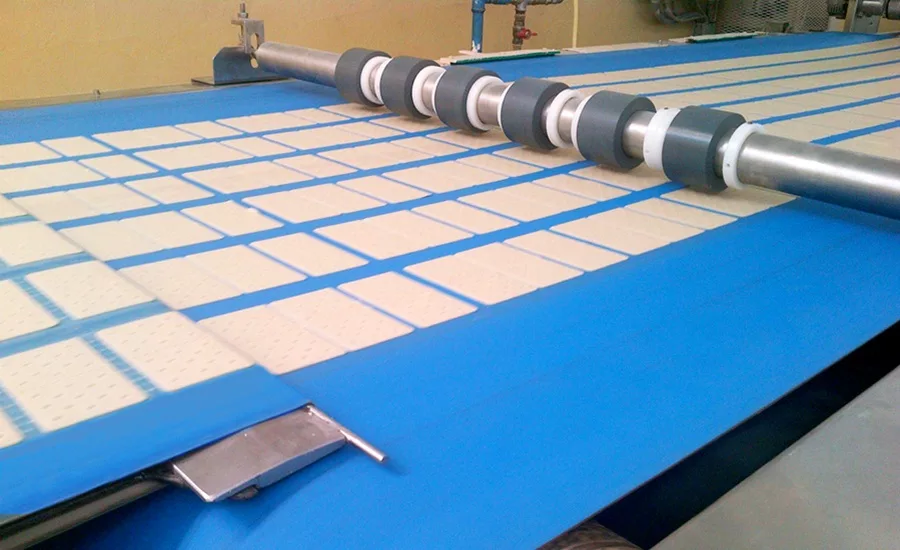
Product handling challenges in baking are rarely uniform. Dough characteristics, moisture content, and surface conditions vary widely across applications, and so do failure points. Soft, unbaked doughs are prone to stretching or sticking. Finished products, such as crackers or cookies, are more susceptible to cracking or breakage. Coated or enrobed items introduce additional risks, including adhesion, smearing, or surface marking.
As line speeds increase, these issues become more pronounced. Faster throughput reduces tolerance for instability, making it essential to design conveyor systems around how products behave in motion, not just how quickly they need to move.
Friction as a process variable
The interaction between product and belt surface is one of the most important, and most frequently underestimated, factors in conveying performance. Insufficient friction can lead to slipping, misalignment, or product collisions. Excessive friction can introduce drag, resulting in deformation, stretching, or surface damage, particularly during sudden changes in speed or direction.
For operators, the goal is to achieve controlled movement. Belt materials and surface finishes should provide enough grip to stabilize products without introducing mechanical stress. Consistency is equally important. Variations in belt surface or wear can create localized disruptions that may only become visible at higher speeds, where small inconsistencies quickly scale into larger issues.
Release performance impacts yield and sanitation
In applications involving sticky doughs or coated products, release characteristics are critical to maintaining both product quality and line efficiency. Products that adhere to the belt can deform during removal, leave residue behind, or disrupt downstream processes. Over time, buildup contributes to increased cleaning frequency and unplanned downtime and poses a significant food safety risk.
Materials engineered for low surface energy can improve release performance, allowing products to separate cleanly without additional force. This is particularly relevant in processes such as dough deposition or enrobing, where sticking can create recurring operational challenges.
In practice, some belt technologies, such as polyurethane-based solutions like Ammega Group’s Ropanyl Premium Plus, are designed to balance controlled friction with reliable release properties. In high-speed bakery environments, these types of materials can help reduce sticking and product deformation while supporting more consistent conveyor performance.
Transfer points are a leading source of product loss
Even with the right belt material, poorly designed transfer points can undermine overall system performance. Gaps, drops, or mismatched speeds between conveyors introduce stress at critical moments in product handling. For brittle items, this often results in breakage. For softer or coated products, deformation or surface damage is more common.
Reducing these risks requires attention to system design. Minimizing transfer distances, synchronizing belt speeds, and using smaller pulleys or nose bars can improve product handoff. In some cases, continuous conveying systems can eliminate transfers altogether.
Product flow also matters. Inconsistent spacing or overcrowding increases the likelihood of collisions, which remain a frequent source of avoidable defects.
Throughput gains depend on stability
Increasing conveyor speed is a common objective, but without stability, higher throughput can come at the cost of higher waste. At elevated speeds, small inconsistencies in motion or alignment can quickly lead to product loss. Sudden acceleration, poor belt tracking, or uneven tension can destabilize products and create variability across the line.
Maintaining stability requires coordination across multiple variables, including belt properties, system layout, and operating parameters. When these elements are aligned, manufacturers can increase throughput without compromising product quality.
No single conveyor fits every product
Conveyor system design in baking is inherently application-specific. Differences in product composition, temperature, and surface characteristics require tailored solutions. What works for a dry cracker line may not be suitable for a soft dough or a glazed pastry. Selecting the right belt and system configuration depends on understanding these differences. This often requires collaboration between operations, engineering, and equipment suppliers to ensure that conveying systems are aligned with product requirements from the outset.
Conveyor systems as a lever for quality and efficiency
As baking lines become more automated and operate at higher speeds, conveyor systems are playing an increasingly central role in determining product outcomes. Decisions related to belt material, friction, release properties, and system design all contribute to how products are handled—and ultimately, how they are delivered to the customer.
For manufacturers focused on improving yield, reducing waste, and maintaining consistent quality, conveyor system design is no longer a secondary consideration. It is a key lever in achieving reliable, high-performance production from dough to done.
Related: Ammega unifies conveyor brands under Ammeraal Beltech
Looking for a reprint of this article?
From high-res PDFs to custom plaques, order your copy today!