Copacking comes together
Successful copacking of baked goods and snacks involves a number of challenges for bakers and snack manufacturers, including the management of labor, inventory and equipment costs. For copackers that do it the right way, however, the ability to venture into new market segments and create new relationships with buyers and retailers are well worth the effort.
A number of bakery and snack plant executives recently shared their ideas for successful copacking with Snack Food & Wholesale Bakery.
Keeping things in balance
One of the tricky aspects to managing the copacking process is to ensure balance in all phases of the business, says Jerry Stokely, president of Axiom Foods Inc., South Beloit, Ill., a corn-based snack food manufacturer. “For example, quality and financial systems set for a specific customer may be at odds with the needs of other customers,” he explains. “This can lead to additional complexities and increased costs.”
Training employees, coordinating production runs and changeovers between products, managing new allergens and ensuring that your equipment needs fit your production lines are major hurdles, according to Mike Alagna, COO at Nation Pizza and Foods, Schaumburg, Ill., a frozen pizza and hand-held foods manufacturer. “In the copacking process, we must be flexible and really manage labor costs,” he adds. “We also must have a bullet-proof quality and sanitation program.”
Rashim Oberoi, president of Simply 7 Snacks, a Houston-based snack food manufacturer, says copacking requires small customization tasks for each client, which can be difficult to manage in the production process. “There’s a lot of legwork and due diligence that goes into creating each client’s product,” he says. “It can sometimes take 12 to 18 months to complete.”
Logistics complications
Location and logistics present challenges as well, according to Nick Braithwaite, plant manager at Gonnella Baking Co.’s bread production plant in Aurora, Ill. “If you’re copacking fresh product for someone out of state, you have to deal with shelf-life factors,” he explains. “If a truck breaks down and doesn’t arrive on time, the copacker may be left waiting.”
Timing and tracking inventory are two additional major factors. “If you’re not controlling the inventory, the copacker may not be able to handle it,” Braithwaite says. “You must supply them with the necessary materials and tools.”
The Gonnella plant manufactures product for three customers and sends bread to a copacker. Managing this can be tricky, according to Braithwaite, so it’s critical that the company’s and copacker’s schedules are in sync. “If a copacker is working for you, they may plan to bring in X amount of people to do the work, so they may not be able to just turn on a dime,” he says. “The details have to be ironed out.”
Managing new products without established volumes in a plant’s production schedule presents another challenge, affirms Kyle Curtiss, CEO and president of Festida Foods, Grand Rapids, Mich., which copacks tortilla and corn chips (See related Festida story in this issue, page TT-8).
Other bonuses
“We look for synergies with our current process and attempt to capitalize on those while maintaining the individuality of our customer’s product,” Curtiss says.
Copackers also allow food developers to build their brands more effectively because copackers can eliminate startup costs for both entrepreneurs and marketers, he adds. “We carry the burden of high capital costs in facility and equipment, so our customers can invest in their business and their brand,” Curtiss says. “That way, they can better spend their money in R&D, material sourcing and marketing; the result is better food and better brands.”
Copacking also allows for more efficiencies and bottom-line growth that can be reinvested into the production facility. “Copacking allows us to maximize the efficiency of our production lines and keep members of our production and quality team on their toes,” adds Oberoi. “They don’t end up seeing the same item over and over again. It also allows us to create a relationship with buyers and retailers that helps our branded side of the business.”
Braithwaite says that copacking allows Gonnella Baking Co. to investigate new market segments. “If you want to enter a new market and don’t have the space or machinery, you can work with a copacker,” he explains. “You can watch and nurture the product, then decide later if you want to stay in that market for the long term.”
Alagna agrees that as new consumer needs arise, copacking allows a company to meet those needs without investing in new production or packaging lines or processes until the item has proven itself in the market. “During the last year, hand-held and snack items have become very popular,” he notes. “After copacking with another company, we invested in new equipment and line modifications to produce these items on our own.”
Generally, copacking makes sense when production facilities and capabilities exist in the marketplace and can be engaged at a price and pace that’s cheaper and faster than what can be accomplished in-house, according to Stokely. “Copacking companies invest in equipment when they see a demonstrated need for that type of product and a market for their unique capabilities,” he notes. “Often, equipment is purchased to meet a customer’s specification or to provide a competitive advantage.”
Copacking carries many benefits in most phases of the business, says Stokely. “From a near-term financial perspective, it often has a superior margin compared with alternative business and cash flow tends to be more predictable,” he explains. “Secondly, a good track record on one project can lead to another project that enhances the long-term viability of the copacker.”
Expanding role
In an ideal situation, the copacker’s role should be transparent to the consumer, says Brian McNamara, vice president, sales and marketing for Hearthside Food Solutions, a Downers Grove, Ill., contract manufacturer of bakery goods and snack foods. “The copacker should increase the capabilities of the customer through additional package formats, brand extensions, seasonal peaks, product introductions, legacy products and other functions that produce new value and capacity for the branded customer,” he notes.
Festida Foods is stretched by different demands from many customers, according to Curtiss. As a result, the copacker knows its equipment better, updates it regularly and adds to its capabilities when needed.
“For example, we are now exploring paper bags as a packaging alternative because of a customer’s inquiry,” he explains. “Left to ourselves, we may have never taken that step, or at least delayed it until the timing was better for us. Instead, we are studying direct-fill and other options, as well as heat-seal and fold-seal applications. So copacking actually makes us better and pushes us to enhance our capabilities as a manufacturer.”
Copacking has prompted many bakeries and snack plants to purchase new equipment. Nation Pizza and Foods recently purchased slicers, patty formers, top-loading cartoners and wrappers to package small, hand-held, dough-enrobed items and snack items, according to Alagna. “Two or three years ago, most of our copacked items were in the pizza category,” he says. “Now, we are copacking appetizers, breakfast and reduced-calorie items.”
Simply 7 Snacks recently purchased a vertical collator that increases the efficiency of packing bags in boxes, as well as automated pallet sealing machines and case-labeling machines. According to Oberoi, the company is always looking at new ways to its automate lines and is trying infrared technology for accessing quality-control measures at the point of production versus taking it to labs. “We are copacking more natural and healthy products compared to two to three years ago,” he says.
The next trends
Will more companies outsource their packaging needs in the near future? McNamara says the latest research shows that outsourced manufacturing, which includes copacking, is growing at a rate significantly faster than the overall food industry. “New companies approach us every year, many of whom haven’t used our manufacturing services in the past,” he explains. “This would suggest that both overall segment growth and the number of companies seeking outsourced manufacturing continue to grow.
“As cross-silo functionality and fully integrated supply chains transform the food industry, the comanufacturing and copacking sectors are under constant pressure to generate perfect quality and low cost. While this has always been a goal of customers, the expectation is now a requirement to compete. The cost and complexity of delivering this value will continue to transform contract manufacturing and copacking sectors.” SF&WB
Sanitation is crucial to copacking 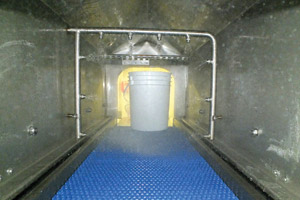
No food processor would knowingly permit pathogens or other contaminants to enter its plant. Yet, when food processors allow packages containing outsourced food ingredients to enter their plants without being sanitized, they take a risk that amounts to the same thing. The end result could be finished food products that are exposed to pathogens or other contaminants, potentially resulting in consumer illness, product recalls, tainted brand names, costly litigation and other consequences.
“The packaging that contains ingredients for foods, such as ready meals, might have been exposed to any number of unwanted substances,” says Mark Corser, CEO of CM Process Solutions, Corona, Calif., an international supplier of hygiene equipment for the food-processing industry. “This is particularly the case among U.S. manufacturers of ready meals and fresh foods, such as sandwiches, or heat-and-eat items, such as fresh (unfrozen) pizza.”
Corser adds that this potential problem exists throughout the U.S., where sanitizing containers coming into a food-processing plant isn’t always common practice. “This is strangely an American problem,” he observes. “In this nation, many food processors use advanced technologies throughout their plants, but when it comes to sanitizing containers as they come to the plant, that is often overlooked.”
A variety of sanitizing tunnel sizes and configurations is available to remedy this potential problem, including design-built, customized models. “Although this kind of equipment doesn’t contribute directly to profits, it certainly qualifies as a good insurance policy against potential recalls for any container-borne pathogens or other contaminants from getting into finished food products,” Corser says. CM Process Solutions offers such equipment, including the heavy-duty, entry-level Ecoscan system.
Farzad Shahsavarani, vice president of operations, fresh food solutions, at Chicago-based Flying Food Group (FFG), which produces food for airline catering, grocery, foodservice and specialty markets, agrees. “There isn’t always a clear understanding when we’re talking about the areas of low risk and high risk or high-care areas in the food processing plant,” he says. “Keeping foods free of contaminants requires a lot more than just walls, doors and traffic flow. Some processors don’t realize that contaminated containers entering the plant can expose their products to environmental impurities and possible pathogens.”
The type of sanitizing equipment to which Shahsavarani refers is often known as a “barrier tunnel” or “sanitizing tunnel” in Europe. The conveyor-belt-driven tunnel sprays a mixture of water and sanitizing agent to disinfect the containers before they are sent into the food-processing plant and opened. Although most detergents kill bacteria and other biologicals on contact, formulas are available to protect containers that are likely to be stored for hours or days.
Looking for a reprint of this article?
From high-res PDFs to custom plaques, order your copy today!