Snack and bakery companies face dust mitigation challenges and safe ingredient handling
Clean, sanitary, dust-free production environments help keep snack and bakery facilities safe.


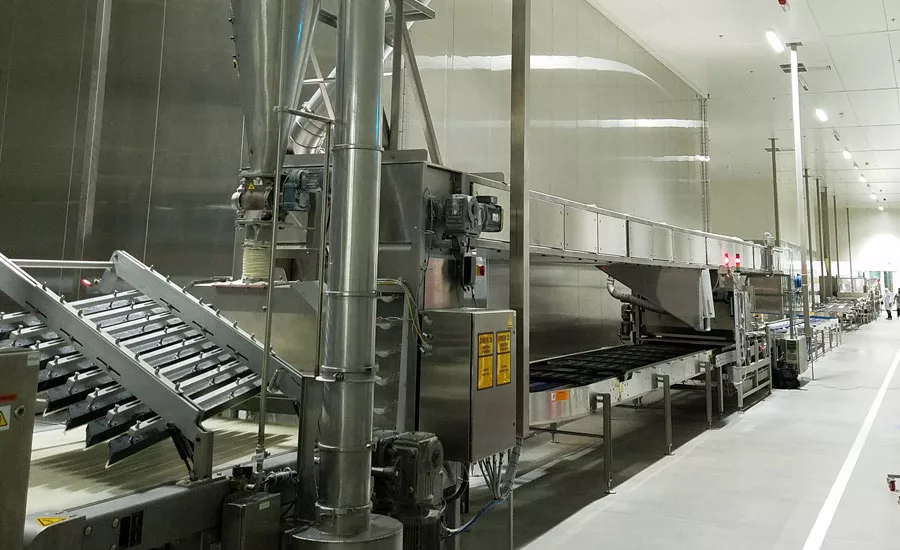

Today’s snack food and bakery manufacturers are focusing on a number of key design features including sanitary equipment design, modularity and smaller equipment footprints, which allow for quick product changeover and smarter controls/designs that also address food safety, says Sharon Nowak, business development manager, Coperion K-Tron USA, Sewell, NJ.
“Coperion’s and Coperion K-Tron’s extensive food product line has evolved to include a number of design features which address many of these concerns,” says Nowak. “A variety of system design options can easily integrate into a snack food system to prevent any ingress of foreign material into the product, or egress of powder out into the plant environment. For example, the Coperion K-Tron line of high accuracy feeders have been expanded to include integration with a glove box/bag dump station combination, and is used when adding such sensitive powders as probiotics or vitamins to a formulation, without contamination concerns.”
The ability to provide options for a variety of cleaning methods is also important when addressing very specific product needs, says Nowak. “For example, a system that is simply conveying flour or sugar may be very different from that which is handling allergens, such as varied nut products.”
Another example of including safe ingredient handling measures in snack food processes includes Coperion’s hygienic line of rotary and diverter valves. “These devices include design options, which not only address food safety but also include options for complete accessibility and wet and dry cleaning,” says Nowak. “Snack food and bakery processors can be faced with the possibility of metal wear or contaminants in their product/process.”
Nowak says that unintended contact between the rotary valve rotor and housing can occur because of a number of issues including:
-
Improper operating conditions (e.g., excessively high temperatures or high pressures)
-
Foreign bodies entering the rotary valve
-
Bearing damage or non-appropriate mounting/maintenance of the valve
Scott Wever, senior project engineer, Hixson Architecture & Engineering, Cincinnati, says that one of the key things that they recommend for safe ingredient handling is having segregated areas designated for ingredient handling only, whether it be dry product or liquids, in order to contain and protect the integrity of those ingredients. “We also recommend having lot tracking once a shipment is received through the addition into the process,” he says.
Warren Green, vice president and manager, process engineering, Hixson, says that the facility side of safe ingredient handling is something that can be easily overlooked, and temperature control and room air balance are a big part of that. “Whether it’s from the USDA, the FDA, or other industry or governing body, products that need to be kept cold have minimum standards that must be met. Most companies should have their food safety plans already in place. However, when it comes to ingredients, you have to consider the entire cold chain to make sure that individual ingredients are being shipped and maintained at the recommended temperatures,” he notes.
“You must have the proper building and mechanical systems to be able to do that, and those systems need to be maintained properly so that they are holding at the correct temperatures. Along with keeping cold things cold is the need to maintain proper air balance in the room, e.g., positive or negative air pressure. Achieving the proper balance between supply air and exhaust air is critical to proper system operation and control,” Green says.
When done correctly, airflow should generally move from the high-hygiene washdown areas to the lower hygiene and non-washdown areas not used for production, Green adds. “Because both airflow and the sources of air can be hard to control during processing conditions, a room pressurization plan is recommended to establish a hierarchy using relative pressurizations. This helps minimize the potential for airborne cross-contamination.”
Wever says: “Cross-contamination, of course, is also about allergen control when we are talking about ingredients. For dry ingredients, you most likely will have equipment such as dust collectors and powder dump stations. It is crucial that these items are cleanable and maintained on a routine basis. If they are not, then there is the potential for allergen cross-contamination between batches.”
Blockchain technology can also assist in the allergen control arena, by allowing companies to track the product, right down to the ingredient level, from the point of origination through to the consumer, Wever comments.
Stuart Jernigan, director of preconstruction, A M King, Charlotte, NC, recommends that minor ingredient handling, including weighing and mixing, should be automated, if possible, to assure proper mix balances in a separate room from the main production floor. “Separate exhaust and dust control systems should be installed in the room to achieve a negative environment in relation to the final mix area. If allergens are introduced, this should be separate from all other areas and sanitized at regular intervals.”
Kevin Pecha, sales manager, AZO Inc., Memphis, TN, says safe ingredient handling requires conscious procedures for the prevention of contaminants entering the system. “This includes proper equipment design to prevent the introduction of contaminants into the system, the need for proper screening of all ingredients, and regular inspection and maintenance of filters and screen material. Continuous efforts need to be instilled in all food personnel to look for opportunities whereby ingredients can be adulterated. Sanitation plays a large portion in providing this effort, both internal to the equipment as well as externally.”
Managing dust
Wever says that to keep dust to a minimum, pick up points are a big deal. “For example, if you have a dust collection pick up point in a 40˚F space and you run that through the facility right through an ambient space, you have the potential for condensation to build up on the exterior and interior of that run. When you shut them down for the night or the weekend, the bacterial load around that condensation can now build up and run back into the system right into the processing area,” he says.
“This may seem like it would be hard to do, but it does happen,” says Wever. “Hixson recommends following best practices for industrial hygiene for ventilation and pick up point design provided by the American Industrial Hygiene Association, as well as proper design of line velocities to help prevent dust accumulation from dropping back down into dosing stations.”
Green says that in order for a dust collector to work properly, you have to have the right air balance in the space. Proper air pressurization helps dust collectors work properly. “At your dump stations you should try to keep that dumping distance to a minimum. If you’re adding products into a blender, you don’t want to dump from seven feet before you hit the blender. Dumping from that high will create a large dust cloud, which will be hard to capture. You want to try to minimize the cloud by dumping the ingredient as close as possible to the blender.”
Jernigan says that a central dust collection/reclaim system can be utilized. “Reclaim is useful when working with a single ingredient, such as flour, for dusting. In addition, the overall plant ventilation system can be designed with a high amount of air changes per hour, controlled by fans equipped with variable frequency drives and high efficiency filtration systems. That way, dust and outside pollution is minimized, and employee comfort improves in areas on high heat introduction, such as cook areas.”
Dust must be seen as the carrier of future problems, says Pecha. “As such, any system that may create dust must be investigated. In the event that dust escapes, a response to correcting must be swift to prevent a more extensive sanitation issue. Proper ventilation, use of proper filtration system, and secure connections can be part of a solution to minimizing dust generated by the system. A lesser-known source of dust is in the disposal of opened bags and containers of the ingredients—the system can provide proper protection once introduces, however the operator can generate significant issues in improper handling of empty bags,” he says.
A systematic approach to dust mitigation should be the goal of all employees within the process; any opportunity to reduce the release of dust benefits not only the finished product, but also sanitation requirements, says Pecha.
Chuck Kerwin, general manager, AZO Inc., says that powered ingredients that unintentionally leak from equipment is sometimes called “fugitive dust.” This dust is both unsightly and a very real threat—a health risk for operators and a combustion risk in your plant, he says. “At AZO, we contend that good dust control starts with good equipment design. Minimizing dust in and around bulk material handling systems, which usually includes a series of separate components working together, is most effective when less dust is allowed to escape from the entire material handling system.”
Even better are equipment designs with built-in dust control, Kerwin recommends. “This feature can return ingredient dust back to the ingredient product stream, reducing product lost in central dust control systems. Equipment with superior dust control features may have a higher up front cost, but the benefit in the long run is lower operating and housekeeping costs.”
Nowak says that it is important to note that for ease in cleaning and product changeover as well as minimizing dust and product loss due to manual material transfer methods, automated snack food material handling and conveying designs are available to ensure minimal downtime and to ensure the system is completely cleaned and safe. “One such option in conveying methods is the use of dilute phase or dense phase vacuum transfer methods. An advantage of a vacuum system would be inwards leakage created by the vacuum blower. This is one of the reasons why vacuum systems are often used in higher sanitary or dust containment applications,” she says.
However, due to the limitations in the level of vacuum that can be generated, the distances and throughputs on a vacuum system can be limited, Nowak notes.
“Oftentimes, a combination of pressure and vacuum conveying are used for a system, taking full advantage of the process and efficiency of each technology. The equipment manufacturer must always discuss in detail with the end user the methods of cleaning that will be used for the process and the design details, which can minimize dust accumulation,” says Nowak.
For example, the integration of retractable spray balls into the design, if a clean-in-place (CIP) process is possible, or minimal horizontal ledges, which can easily wiped clean for dry cleaning. “By including upfront design features that focus on ease of cleaning as well as accessibility, overall snack food process times can ensure product safety,” says Nowak.
Glenn Campbell, president, Campbell Systems, Inc., Atlanta, says that flour-borne pathogens can easily transfer from makeup to packaging, bypassing the “kill step” and contaminating otherwise pristine product, with no possibility of detection. Also, excess dust may also be transported by personnel and equipment from zone-to-zone even if barriers are present.
Campbell recommends the following to balancing production, safety and efficiency, at practical costs:
-
Recognize the risks inherent with dust, and allocate sufficient budget to deal with it
-
Custom-fit solutions, modern designs, and appropriate material selection will all reduce ongoing sanitation costs and operating expenses, including compressed air and fan horsepower savings, with less noise
-
Look for the intangible savings, such as the impact on your facility air handling equation, since failure to control dust can wreak havoc on your building filtration systems
Campbell also notes that if employees are wearing masks for COVID protection, excessive airborne dust will impede their flow and render them less or completely ineffective. “It is common practice to utilize compressed or forced air to fluidize dust for sanitation or product quality—it is critical that flour dust collection systems be properly designed and maintained to prevent dust from becoming airborne. Cyclonic pre-separators, new filters, and properly adjusted hoods allow dust fluidization to be safely accomplished.”
Regarding COVID-19, Pecha says that the less a person comes in direct contact with the ingredients and finished goods, there is less opportunity that the virus can be passed along. “Automating the handling of the ingredient, process, and packaging helps to minimize the impact. Proper screening upon entry to the facility and rigorous monitoring and sanitation related to personnel is a minimum.”
Addressing obstacles and challenges
“Equipment design and production line layout is crucial,” says Wever. “Even today, there are still some equipment design practices which are less than ideal, such as those that require manual disconnects, multiple operator interventions, or poorly written standard operating procedures (SOPs). Instead, we want to reduce activities requiring multiple operator workstations in a confined area, and minimize the work of the sanitation and maintenance teams as much as possible. This can be done through maintenance and operability reviews of the line layouts during line layout design, and by incorporating CIP practices into the design of the lines. For example, adding CIP into a continuous oven provides a potential cost savings opportunity by reducing the amount of manpower required, with less people working shoulder-to-shoulder.”
It’s also important to regularly recalibrate your systems, says Wever. “Let’s say you’ve designed your line to have proper air flow, proper humidity control, etc. If you are not periodically recalibrating your systems, you may think everything is fine, but eventually, you may have some food safety issues.”
Green says that safe ingredients handling starts right at the beginning of the facility project. “You can cut corners on building design and materials selection, but eventually you’ll pay for it later. It’s no different with sanitation and maintenance. You can skip the oil changes and tune-ups on your car, but eventually, your car is going to have a spectacular failure. The same is true with your facility. Invest in the recalibrations. Maintain the mechanical systems, walls and the floors. Yes, plants are tough environments to keep in like-new condition, but doing so will serve you well in terms of food safety.”
Jernigan says that he are seeing a trend towards “line stretching,” or decreases in line volume to reduce employee density along the production line. “This set up makes disease transmission less likely. The trend could eventually lead to building renovations or expansions to make up for the loss in volume along the line or make up for increased line lengths. The upside to this should be an increase in overall food quality/safety and greater ease of sanitation due to less density of equipment.”
Jernigan also recommends better air quality and pressure control within the plant will continue and accelerate as a priority. “This may result in upgraded HVAC and refrigeration systems with higher levels of filtration. Maintenance, filter cleaning/replacement and unit cleaning will take higher priority.”
Nowak says that this year’s challenging pandemic of COVID-19 has caused a number of food manufacturers to investigate improved methods of manufacturing in order to increase operator/product safety and improve social distancing, while still improving process efficiency. “The use of automated material handling and batching systems is being increasingly implemented to not only minimize manual labor and intervention, but to also improve profit margins by optimizing accuracies for ingredient addition.”
Nowak says that an automated batching system can result in significant improvements in product and process safety as well as product quality. A typical automated system, whether material is being delivered from drums, bags, intermediate bulk containers (IBCs), or super-sacks typically includes an unloading station and then transfer to a batch weighing station.
The batch weighing station, whether for major, minor or micro ingredients, can consist of a variety of weighing methods dependent upon the volume requirements. “The station can include volumetric metering devices, such as a screw feeders or valves, which deliver the product to a hopper on load cells. Typically, the major ingredients—such as flour, salt, sugar, etc.—are weighed via gain in weight batch type methods prior to entrance to a mixer. Additionally, higher value ingredients such as flavors and additives, which may require more accurate weighed amounts, may be added via loss-in-weight batch methods,” notes Nowak.
This method includes gravimetric feeding devices, such as screw or vibratory feeders, mounted on load cells or scales, which deliver the product to the process by means of loss-in-weight (LIW) feeding. “In some cases where small amounts of micro ingredients are required for a total overall batch, both methods are employed: LIW feeders for the micros and minors, and GIW batchers for the major ingredients,” says Nowak. “The use of automated dispensing systems that can also integrate pneumatic conveying systems for material transfer can greatly reduce the amount of human interaction as compared to manual methods of weighing and transfer.”
This maximizes social distancing and adheres to strict COVID guidelines of safety, says Nowak. “Properly weighing and accurately delivering the ingredients without manual intervention can result in a number of process advantages, including overall food safety, fewer mistakes, better accuracy, lower bulk costs, improved product quality and savings in manufacturing costs.”
Looking for a reprint of this article?
From high-res PDFs to custom plaques, order your copy today!