Icelandic salts add flavor, flair to snacks and baked goods
According to Saltverk, the ingredient does more than improve the taste of foods.
As a bakery and snack ingredient, salt goes beyond functionality and taste enhancement. What’s more, producers can reach for salts in different formats, sources, and even smoked varieties to give a product a unique touch, whether added into or onto goods. To find out more, we checked in with Gisli Grimsson, saltmaker with Iceland-based Saltverk.
Jenni Spinner: Could you please tell me about Saltverk—the history of the company, products you offer, etc.?
Gisli Grimmson: Saltverk is hand-harvested, sustainable sea salt from the remote Westfjords of Iceland. Produced using 100% geothermal energy and only one raw material, the pristine seawater of the region. The pure flavor, ingredients, and sustainable production of our salt really set it apart.
The production method that we use is based on the process that was put into action by the Danish king in the 18th century. A few decades after its establishment, the practice of saltmaking in Iceland came to an end. However, the art was not gone forever: The 2011 founding of Saltverk marks the re-establishment of traditional salt production in Iceland.
In 2011, during the early years of the New Nordic cuisine movement, Björn Steinar Jónsson founded Saltverk while finishing his engineering degree in Copenhagen, Denmark. The project was born out of a passion for food, sustainability, and Icelandic pride.
Our production facility is located on the Reykjanes Peninsula, which separates two fjords and is surrounded by high mountains. Reykjanes, where the North Arctic Ocean current runs to the Bay of Ísafjarðardjúp, has some of the purest and most mineral-rich seawater in the world, giving our salt a distinct, umami flavor profile.
The process uses 206ºF geyser water from the springs of Reykjanes. The saltwater is pumped into open pans, where it is preheated and becomes a strong brine with a salinity level of 17-20%. The brine is boiled until white crystals appear on the surface. The salt is harvested from the bottom of the salt pans; any remaining liquid is drained, and the salt is dried and packaged.
The result of this process is a handmade, pyramid-like, crystal salt flake that contains the flavor and taste of the Nordic region from which the seawater is derived. The finished product includes minerals necessary for human life, with zero chemicals or anti-caking agents.
The entire process is completed by using 100% geothermal energy from Iceland’s hot geysers, resulting in zero carbon footprint as well as no CH4 emissions, making us one of the few entirely sustainable flaky sea-salt producers in the world.
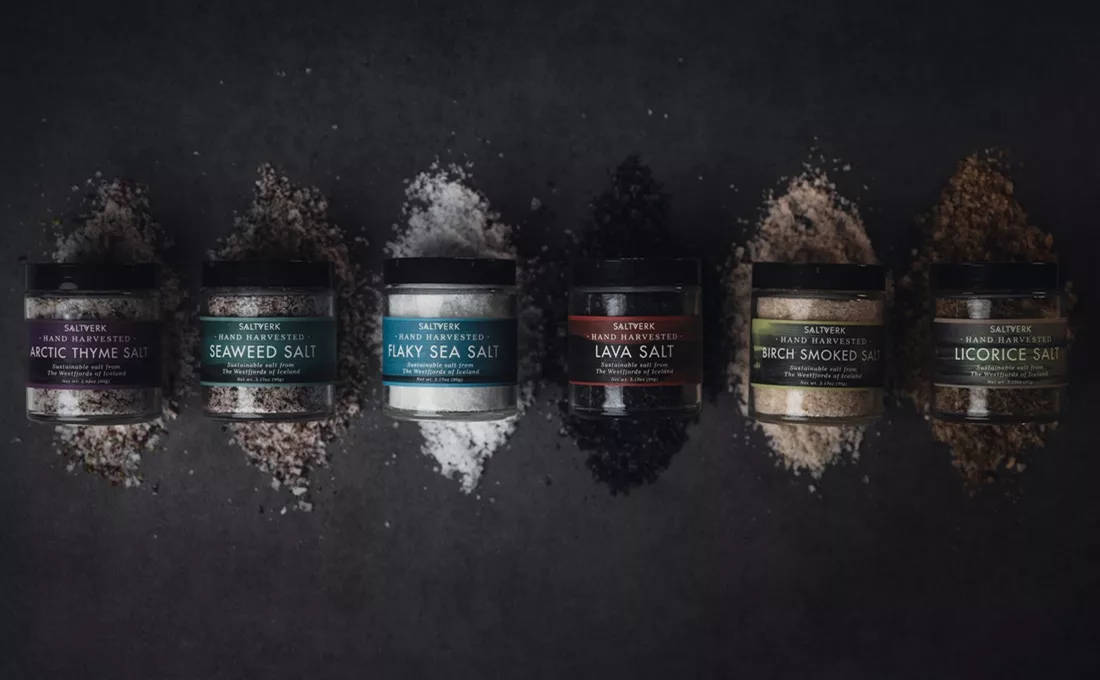
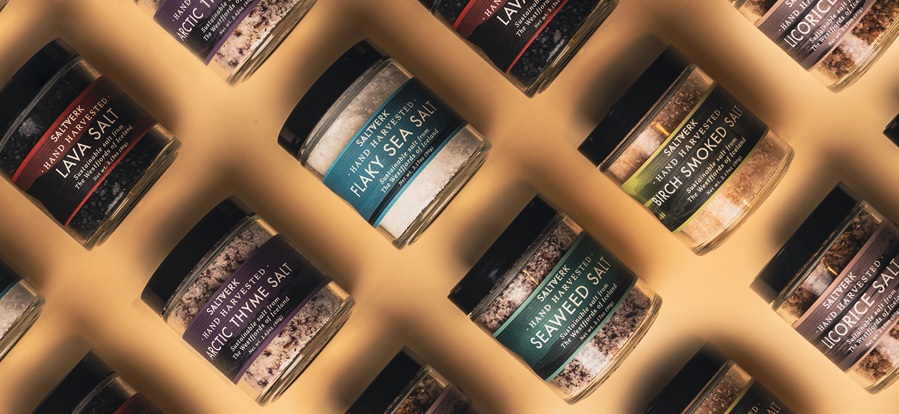
We make six flavors inspired by Icelandic cultures, customs, and traditions: Pure Flaky, Birch Smoked, Arctic Thyme, Lava, Licorice, and Seaweed.
JS: Our audience knows about the important and diverse role salt plays as an ingredient in foods, for taste and function, but could you please talk a bit about what else it can do?
GG: Salt does far more than add a salty note—it’s one of the most versatile and important tools we have in cooking. It brings balance, sharpens flavors, enhances sweetness, and generally improves or boosts other flavors in food. Salt also influences texture from strengthening gluten in breads and doughs. For protein, it helps retain moisture and can certainly be used for extending shelf life of a product by acting as a natural preservative.
When using salt on the outside of food, you add another layer of texture. This is different from dissolved salt in foods. It can add crunchy, flaky texture, and salt dissolving on your tongue has a totally different sensory effect than it does when incorporated into food. That is very consistent in snacks and baked goods, where salt is also used as an item or ingredient to pop up the whole experience. One of my personal favorites is Salt Sticks—such a simple snack, but delicious and good for any occasion!
 Courtesy of Saltverk
JS: I’m a huge salt fan—I had eight different kinds in my pantry before you were kind enough to send me samples of yours (the standard salt, and the birch-smoked), but still I don’t know nearly as much as you do about the different sources, crystal sizes/types, flavors, etc. Could you please tell us a little bit about the different types and what they might be best suited for?
GG: Sure:
- Flaky Sea Salt: Hand-harvested from the cold, clean seawater of Iceland and made using our geothermal energy, this salt stays light, crunchy, and full of natural minerals. Great all-purpose salt. Adds clean, bright crunch to vegetables, eggs, grilled meats, salads, and baked goods. Ideal for everyday cooking, baking, or finishing.
- Birch Smoked Salt: Our flaky salt is smoked with Icelandic birch for more than 48 hours, following the old traditions that have shaped our food for generations. Perfect for adding a natural smoky flavor. Works well on roasted vegetables, grilled meats, fish, eggs, stews, and even simple buttered toast. My favorite way to use it is in guacamole, it adds some smoke and a nice subtle sweetness.
- Arctic Thyme Salt: We infuse our flakes with wild Arctic thyme that we hand-pick. Arctic Thyme is an aromatic and floral herb that is found only in Iceland, Greenlan,d and the Faroe Islands. It is excellent on lamb, roasted potatoes, root vegetables, game, vinaigrettes, and anything that benefits from a herbal lift.
- Seaweed Salt: We combine our flakes with hand-foraged Icelandic seaweed, a mix of dulse and sugar kelp. The result is a natural umami depth with a saline, earthy character that reflects the North Atlantic shoreline. Ideal for seafood, rice, ramen, vegetables, broths, and dishes that need a little extra depth. Also great on popcorn.
- Lava Salt: To create the Lava Salt, we mix the Pure Flaky salt with activated charcoal to create a black salt inspired by Iceland’s volcanoes. The taste stays clean and mineral-rich, and the crisp flakes bring both flavor and a striking look to any dish. Best as a finishing salt for visual impact on steaks, eggs, seafood, and desserts. It's pretty popular for cocktails and rimmed glasses.
- Licorice Salt: Mixed with natural licorice root, this flaky sea salt carries a bold Nordic balance of sweet and salty. It is a flavor deeply rooted in Icelandic food culture and one we are proud to share. Perfect for chocolate, caramel, cookies, ice cream, and popcorn. Also works beautifully in savory dishes like roasted carrots or pork.
JS: Then, among the different salt purveyors, what makes Saltverk and its products special? Feel free to talk about the offerings for food producers like the bakers and snackmakers that read our publication, in addition to home chefs.
GG: We are one of the few producers in the world producing sea salt entirely with geothermal energy, using a method that keeps the process both clean and true to Icelandic tradition. The seawater comes from one of the most pristine coastlines on the planet, and everything is done by hand, in small batches, by people who live and work in the Westfjords. The result is a salt that tastes bright and clean, with a natural minerality that comes directly from the North Atlantic. For chefs and home cooks, that purity shows up immediately in the way the flakes break, melt, and finish a dish.
What sets Saltverk apart for food producers is the consistency and integrity of the product. Bakers appreciate how the flakes hold their structure on breads, pastries, cookies, and caramels. The minerals in the salt enhance browning and bring a balanced sweetness to baked goods. The flavored salts offer natural, recognizable ingredients like real birch smoke, wild seaweed, Arctic thyme, and natural licorice root.
For home chefs, our salts can make any dish feel special. The flakes add texture along with flavor, whether sprinkled on eggs, grilled vegetables, chocolate desserts, or cocktails. The flavored varieties give people an easy way to explore Icelandic ingredients without needing to source herbs or seaweed themselves.
Overall, we combine craftsmanship, sustainability, and a strong sense of place. In a category where many salts are industrial or heavily processed, we offer a product that reflects the environment it comes from and the hands that make it.
JS: What advice do you have for food folks looking to incorporate products like yours into their recipes?
GG: My advice is, don’t be afraid to test and figure out what works best for you. We are all different, and even though there are some pairings that are “made to be” such as Licorice salt and beetroots or Seaweed salt and seared chicken thighs, our flavor profiles differ on a personal level. A lot of people love bitter salads, while others despise them; neither party is right or wrong. It’s just personal preference and to what traditions you were brought up with. My best advice is to reference our website saltverk.com, where we have lined up the best pairings and how to use each of our products!
JS: Finally, do you have a favorite salt among your products, and what’s your favorite way to use it?
GG: My personal favorite (except for the plain Flaky, which I use the most) would be our Birch smoked salt. It’s really nice on soft-boiled eggs, a killer rim salt for a mezcal margarita, and my secret ingredient in home-made guacamole.
Looking for a reprint of this article?
From high-res PDFs to custom plaques, order your copy today!