Efficiency and easy changeover top the list of seasoning and coating must-haves
Demands on food producers require equipment selectors to be demanding of their gear.
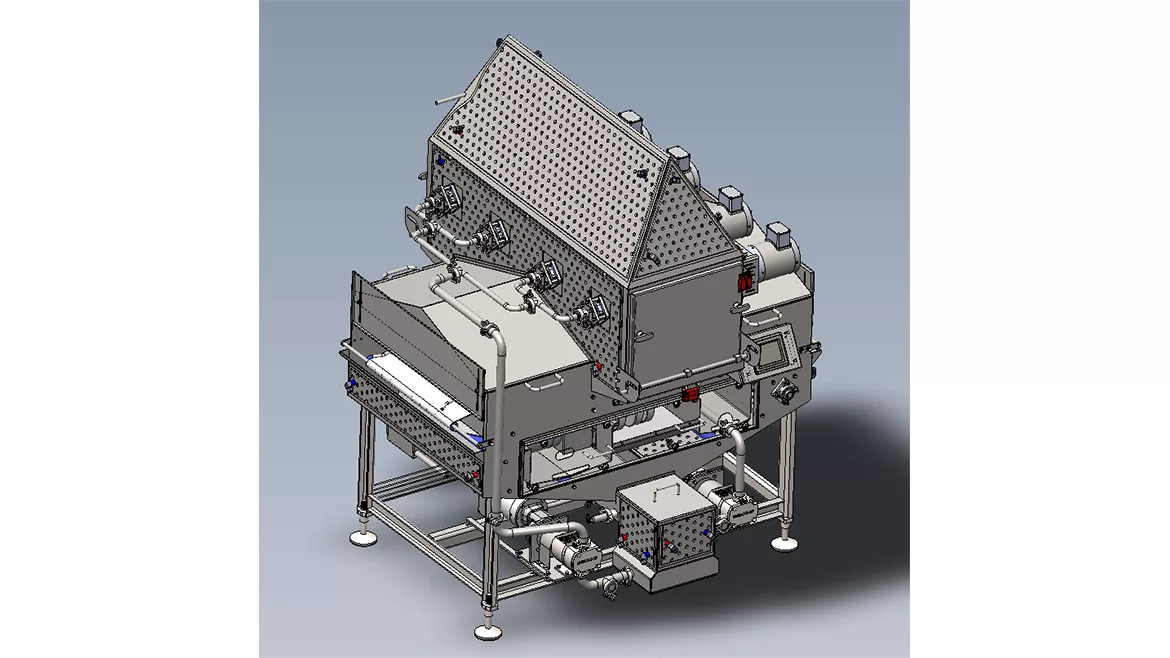
Snack and bakery companies seeking new or improved seasoning and coating systems are armed with a list of must-have features. According to equipment manufacturers, these producers are most frequently looking for qualities like accuracy, flexibility, efficiency, operational performance, safety, smaller sizes, and ease of movement and reconfiguration.
Solutions focus
Robert Reiser, president of Wilevco LLC, says customers are increasingly focused on consistency and accuracy of coating, as well as the ability to achieve a variety of flavor profiles.
“They don’t want to just put down some oil,” he notes. “They need to differentiate themselves. It’s usually stuff that would clog a spray bar. Inclusions or flavorings, like a spice mix, it’s got some grittiness to it.”
Operational performance and efficiency are top of mind for customers of General Oil Equipment (GOE), according to Norm Searle, who handles sales and marketing for the company. The most common requests he’s hearing about are for longer production run times, faster changeover, improved sanitation, cost savings, and overall efficiency.
Since snack and bakery companies remain diverse both in terms of size and sophistication as well as their range of products, PPM Technologies works to serve the full spectrum from local plants to multinational manufacturers with different technology, states Nicholas Schoen, marketing manager and product line manager of seasoning and coating: “Larger manufacturers might use multiple units in parallel to create different flavor variations from the same base product,” he remarks.
Across the board, PPM is seeing demand for systems that are flexible in terms of product types, production scales, ease of movement and ease of reconfiguration, Schoen says.
“There’s a larger focus on safety, sanitation, and automation in general, being able to meet very strict hygiene standards and reducing manual intervention, sometimes entirely,” he points out, to cut down on both time and safety risks. “Some of these guys are running 24/7, and floor space is always at a premium. They want compact systems they can integrate easily.”
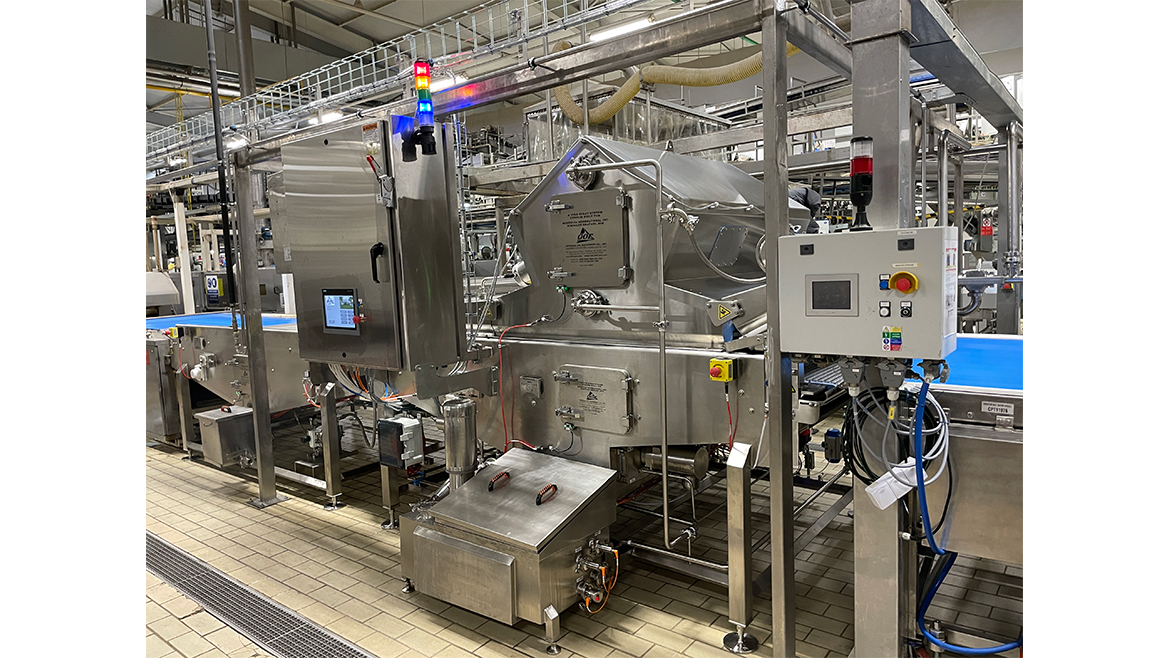 Courtesy of General Oil Equipment
Cross Industry Link, electrostatic seasoning equipment representatives for the Americas for Spice Application Systems, has found customers are sharply reducing the amount of oil or adhesive used in snack and bakery products, which reduces the amount of seasoning used, as well, according to Madalyn Longoria, installation technician.
“You can dial it up or down depending on aesthetic or taste,” she declares. “A lot of them are happy [to use less] because they were often losing a lot of seasoning as it stuck to the drum.”
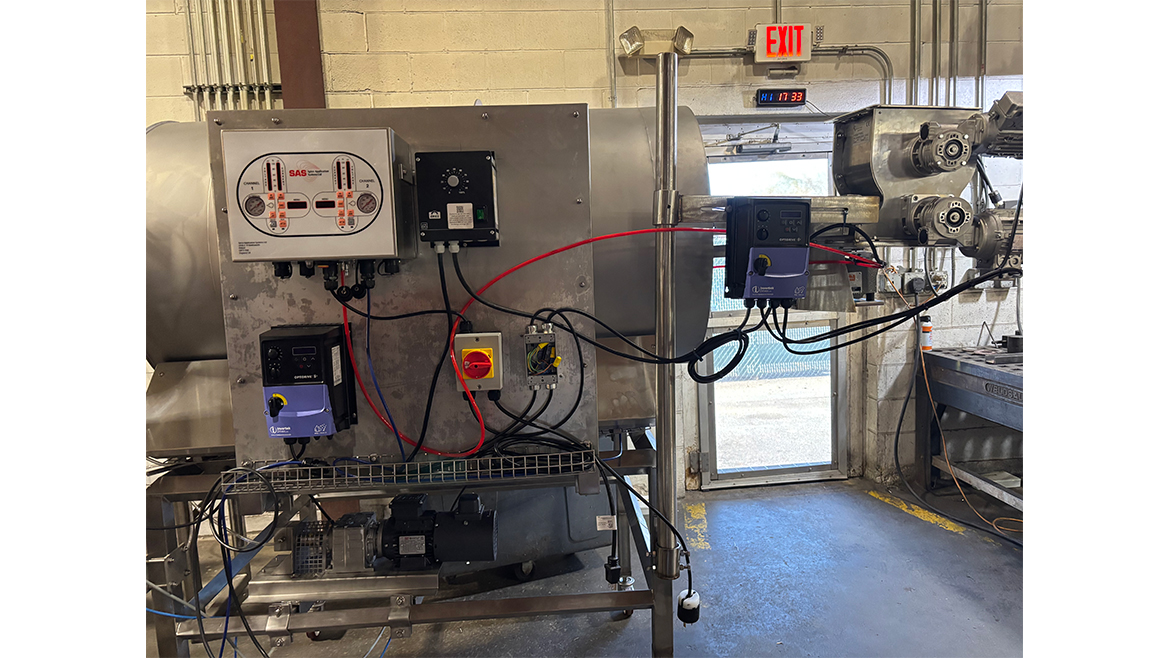 Courtesy of Cross Industry Link
Customers are also looking for machines with a reduced footprint, with “mom and pop” clients in particular needing to fit it into the space they have, and they’re concerned about safety on a number of levels, Longoria says.
“The electrostatic field is contained within the drum, and we have clients with employees who have pacemakers,” she notes, and they’re able to operate the equipment Cross Industry represents. “It is very safe as long as you practice standards and don’t stick your hands in moving parts. And everything is washdown grade.”
Sylvain Courbon, regional sales manager for Canada and the northeastern U.S. at Clextral, explains that his company’s customers want greater flexibility in formulation handling and more precise control over coating performance.
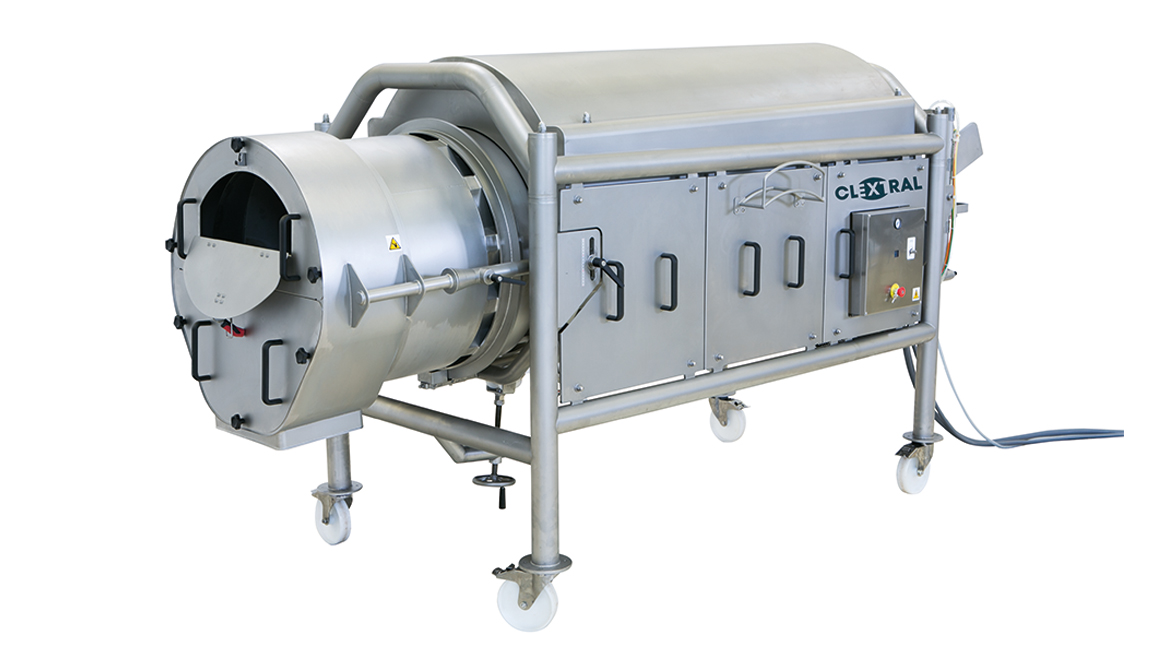 Courtesy of Clextral
“Most applications still involve liquid-based systems, either oil, or water, or hybrid, depending on flavor profile and target texture,” he notes. “However, there is increasing demand for two-step systems combining a liquid base followed by sugar or dry ingredient layering including flavor and vitamins. This allows manufacturers to create more complex sensory profiles and visual differentiation.”
Simultaneously, ingredient systems are becoming more technically demanding, with natural flavors, alternative sweeteners, reduced-sugar systems and plant-based ingredients often presenting more complex rheological properties—they can be highly viscous, heat-sensitive, or prone to phase separation, Courbon states. This requires systems that control shear stress, maintain phase stability and prevent liquid-solid separation: “Temperature regulation is also critical, particularly for sugar-based coating, where crystallization must be carefully managed to achieve the desired glossy or frosted surface appearance,” he argues.
Many of these coating technology requirements stem from health-driven innovations, with manufacturers employing natural colors and flavors, sugar reduction and alternative sweeteners, and lower salt and oil content—and yet needing to meet consumer desires around taste and texture, Courbon remarks.
“This combination creates a technical paradox,” he says. “Lower inclusion levels demand higher distribution precision. When seasoning levels decrease, homogeneity becomes even more important because flavor perception depends on consistent coverage.” In addition, premium ingredients and complex flavor systems are increasing cost sensitivity, reinforcing the importance of precise dosing and uniform application, he notes.
Questions to ask
Customers in the market for new or improved seasoning and coating systems need to ask manufacturers an array of technical questions about the equipment and technology, regarding throughput, sanitation, accuracy, integration, and the like, according to Schoen of PPM. But what often gets overlooked is how a given piece of equipment fits into a company’s short- and long-term goals, he says.
“Budgets are what they are,” Schoen adds. “But it’s important to understand a machine’s full capabilities—and its limits. If the business scales, can the system scale with them, or do they need to replace it?”
While companies sometimes approach PPM with specific use cases, at other times they’re looking for an all-in-one solution but don’t have a good sense of their capacity needs, Schoen declares.
 Courtesy of Clextral
“They don’t know what they’re going to be asked to produce in six months or 12 months because of an increase in consumer demand,” he points out. “It’s important for them to understand the limits of the system. What are their upgrade options, so they can make a smart decision on how flexible they can be to meet their demands down the road? Customers are looking for what they need right then, but not how it’s going to fit their goals a year from now.”
Longoria of Cross Industry Link appreciates queries about how many seasonings can be used, along with a list of the seasonings the customer wants to use. “We’re able to help them get that to run through the line easier, if we know how many seasonings they have,” she notes. “I have 12 seasonings—can the system handle it? We say, ‘Absolutely. Here are your options.’ Or if they have a weird takeaway conveyor system that’s hand-fed [they might ask], ‘Would this fit with our current process?’”
Customers should be digging deeper than just asking about specs, according to Searle of GOE. Among the questions he encourages snack and bakery companies to ask: “Have you successfully implemented this type of application before? Can you provide preferences? What is the typical changeover time? How long does allergen cleaning take? What are the ongoing costs for consumable spare parts?” With answers in hand, customers get beyond the initial purchase price to “uncover the real long-term cost, performance expectations and operational impact of the equipment,” he adds.
Reiser of Wilevco suggests that prospective customers ask manufacturers what kind of consistency a system can produce with seasonings and coatings.
“You’re going to get high and low spots,” he says. “Quite often, the coating costs more than the product. You want full coverage, but you don’t want to put any extra on.” Another key issue is temperature control, Reiser adds. “Generally, things that are colder will stick better. Can I cool—or do I have product where I have to heat the coating and need to keep it in a [certain] temperature range? What kind of pickup levels am I looking for? How much coating do I want on there?”
And then, taking a step back, Reiser would ask questions about labor savings: “How will it integrate and act [in concert] with upstream and downstream equipment, so we can minimize the labor, and the people we need on it, and still get a consistent product?” he asks.
At the outset, Courbon of Clextral would ensure that the equipment and technology can handle the full viscosity range, shear sensitivity and thermal behavior of their formulations. Next, evaluate the system’s flexibility across coating rates, including whether it can perform consistently at both high and low inclusion levels as well as support both single-step slurry systems and two-step liquid-plus-powder applications, he suggests.
“Precision control is another critical factor,” Courbon says. “Since coating can represent a significant portion of total product cost, accurate and repeated dosing directly impacts profitability, Finally, hygienic design and cleaning capability should be carefully reviewed. Modern production environments require sanitation standards that support food safety, rapid changeover, and operational reliability.”
In addition, snack and bakery companies need to think beyond the purchase of equipment to learn about the level of technical partnership the manufacturer is offering, Courbon notes.
“Selecting a supplier is not only about machinery performance. It is about long-term collaboration,” he argues. “In an environment where formulation complexity and market expectations continue to evolve, having a technology partner committed to long-term performance and innovation makes a decisive difference.”
Looking for a reprint of this article?
From high-res PDFs to custom plaques, order your copy today!