Pre-portioned pancake package wins award
The innovation took silver in FPA's 2025 student packaging design challenge.
Courtesy of the Flexible Packaging Association
The Flexible Packaging Association (FPA) has announced the winners of its 2025 Student Flexible Packaging Design Challenge. This year’s first-place innovation, the EZ PB&J Pouch, was designed by students from the Rochester Institute of Technology (RIT). The second-place-winning Pancake Pack was made by a team from California Polytechnic State University (Cal Poly).
The annual challenge is part of FPA’s broader Achievement Awards program, which highlights innovation across its membership. Since 2004, the student competition has aimed to support future packaging engineers and designers by recognizing concepts that address real-world functionality and sustainability.
The first-place concept, the EZ PB&J Pouch, was developed by RIT students Travis Daly, Jacob Marrer, Olivia Morris, Austin Pralow, and Amanda Szymanoski, under the direction of Dr. Kyle Dunno, department chair and associate professor. The single-use pouch features separate compartments for peanut butter and jelly and is designed for school lunches. Its bread-shaped silhouette includes an ergonomic tear notch for ease of use and is intended to eliminate the need for spreading utensils. The concept also received the “Best Video” award, which will be featured on FPA’s digital platforms.
“The FPA student design competition gives our students a unique opportunity to engage with industry-relevant problems and showcase their innovative thinking,” says Dunno. “It is rewarding to see their hard work recognized on a national stage. This competition continues to be a powerful catalyst for student growth. It pushes them to think critically about packaging design, sustainability, and real-world functionality.”
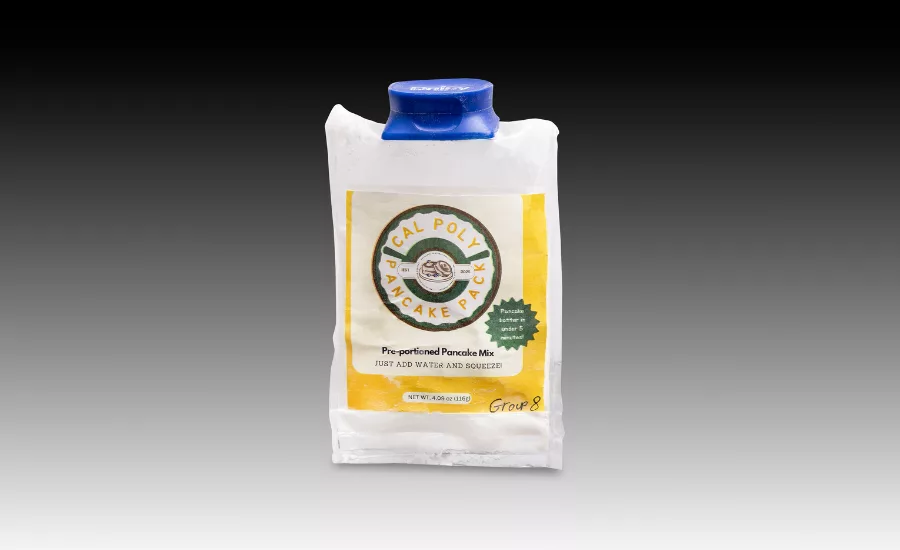
The second-place concept, the Pancake Pack, was developed by Cal Poly students Matteo Mazziliano, Emma Powers, Henry Wright, and Kyle Zheng, under the direction of Dr. Joongmin Shin, associate professor. The package is designed for pre-portioned pancake mix and aims to simplify preparation by eliminating the need for measuring cups and mixing bowls. The team selected ionomer film for its strength, clarity, and barrier properties, with the goal of maintaining freshness and reducing environmental impact.
With its intuitive design and waste-reducing features, the Pancake Pack shows how packaging innovation can enhance everyday experiences and support sustainable practices.
For the 2025 competition, FPA received 56 concept outlines from top packaging design programs across the U.S. Of those, 16 were selected to move forward to the development phase.
The annual challenge is part of FPA’s broader Achievement Awards program, which highlights innovation across its membership. Since 2004, the student competition has aimed to support future packaging engineers and designers by recognizing concepts that address real-world functionality and sustainability.
The first-place concept, the EZ PB&J Pouch, was developed by RIT students Travis Daly, Jacob Marrer, Olivia Morris, Austin Pralow, and Amanda Szymanoski, under the direction of Dr. Kyle Dunno, department chair and associate professor. The single-use pouch features separate compartments for peanut butter and jelly and is designed for school lunches. Its bread-shaped silhouette includes an ergonomic tear notch for ease of use and is intended to eliminate the need for spreading utensils. The concept also received the “Best Video” award, which will be featured on FPA’s digital platforms.
“The FPA student design competition gives our students a unique opportunity to engage with industry-relevant problems and showcase their innovative thinking,” says Dunno. “It is rewarding to see their hard work recognized on a national stage. This competition continues to be a powerful catalyst for student growth. It pushes them to think critically about packaging design, sustainability, and real-world functionality.”
The second-place concept, the Pancake Pack, was developed by Cal Poly students Matteo Mazziliano, Emma Powers, Henry Wright, and Kyle Zheng, under the direction of Dr. Joongmin Shin, associate professor. The package is designed for pre-portioned pancake mix and aims to simplify preparation by eliminating the need for measuring cups and mixing bowls. The team selected ionomer film for its strength, clarity, and barrier properties, with the goal of maintaining freshness and reducing environmental impact.
With its intuitive design and waste-reducing features, the Pancake Pack shows how packaging innovation can enhance everyday experiences and support sustainable practices.
For the 2025 competition, FPA received 56 concept outlines from top packaging design programs across the U.S. Of those, 16 were selected to move forward to the development phase.
Related: Sustainable packaging for snack food and wholesale baking products
Looking for a reprint of this article?
From high-res PDFs to custom plaques, order your copy today!